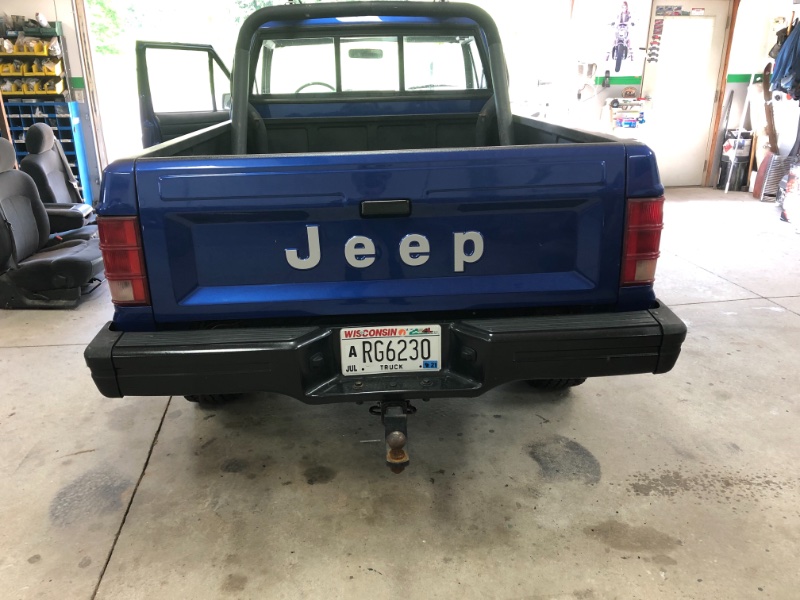
There were three main rear axles found in the Jeep XJ, all of which should be fairly easy to swap into our Eagles. The three options are as follows:
AMC/Dana35
Chrysler 8.25 (available in both 27 and 29 spline axle shafts)
Dana 44
There are four gear ratios found in these rear axles that would be fairly available. They are as follows, along with the engine/trans combo they came with:
3.07: 4.0, manual trans
3.54: 4.0, automatic trans and 4cyl, 4 speed
3.73: Some early (1984-1986) XJs had these. Not sure on engine/transmission combos
4.10: 4cyl, 5 speed
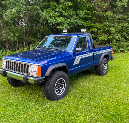
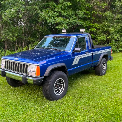
Note: a Jeep MJ Comanche has the same width rear axle, but the perch width is different and they are spring under axle, not spring over like XJs and our Eagles are. Comanches did also have an AMC20 rear axle available in the 1986 model year only.
I had previously read that the XJ axle swap is bolt in, with the exception of the shock mounts. This is both true and not true. The axle itself is a bolt in swap, other than needing to move the shock mounts, but there are some things to be aware of.
1. The pinion snout on a D44 or Chrysler 8.25 is 1" longer than that of an AMC/D35, so the driveshaft will need to be shortened. I was able to just barely get away with not shortening the shaft as my car has roughly a 3" lift in the rear.
2. The diameter of the axle tube for a D44 or Chrysler 8.25 is larger than that of the stock rear axle. You will need the U-bolt plates out of your donor vehicle for this swap.
3. The brake line t fitting is on the other side of the rear end. On an XJ, the t for the lines/hose is roughly in the middle on the left side of the axle. The t for an Eagle is near the right side axle perch.
4. I read that the pinion angle is correct using XJ perches. I do not think that it is, the pinion is pointed towards the floor a little bit more than I would like. That said, my car has a lift, so that may not be the case with a stock height Eagle. I will also say, even with this pinion angle not being 100% correct, it is not far enough off to the point that I worry about the pinion bearing not getting enough oil. I've also had my car up to 80 since the swap with no driveline vibration. I didn't dare push it any harder than that
5: I personally did an 8.25 swap in my car and would do it again. Even the u-joint was the same size.
What axle is right for you? That depends. I'll lay out the pros and cons of each below.
Dana 35:
Pros: Easiest swap. The axle tube is the same size, so the Eagle u-bolt plates and be reused. These also do not have the longer pinion snout, so the driveshaft will not have to be modified. It will also be the easiest one to find. Closest to the stock Eagle rear end.
Cons: It is the weakest unit of the three that I listed. There were two styles: one with c-clips and one without c-clips. The change happened sometime around 1990. Neither are very good, but the non c-clip is better. I personally would not do this swap. I do not believe that the ease outweighs the weakness of the axle.
Dana 44:
Pros: Its strong. Dana 44s are used in new Wranglers and were found in a lot of trucks from the 60s-90s. I would also call it the most "correct" upgrade since they were found in Jeeps from the same era that the Eagle was in production.
Cons: These things are expensive, I looked for one for 3 years and never found a reasonable one. Most I've seen have gone for $400-$600. You will need different u-bolt plates as the axle tube is larger. The pinion snout is 1" longer, so your driveshaft may need to be shortened.
Chrysler 8.25:
Pros: Plentiful, these came in a lot of Cherokees from the mid 90s-2001. They aren't that expensive either. I picked mine up for $75 and it came with wheels and a front axle. It looks very similar to a Dana 35, so many people cannot tell them apart. If you're building a sleeper Eagle, this may be a good option if you want your car to look stock underneath. These were available in 27 and 29 spline. Before 1997, all 8.25s were 27 spline. Starting in 1997, all 8.25s were 29 spline. The 29 spline is better, but either are an upgrade. Almost as strong as a D44 for a fraction of the price. This will live behind a mild V8 or stroker I6.
Cons: You will need different u-bolt plates as the axle tube is larger. The pinion snout is 1" longer, so your driveshaft may need to be shortened. It isn't period correct. These came out in the 90s, years after Eagle production ended.
Why not just swap in a Ford 8.8?
My Dad built a YJ with an Explorer 8.8 and my Comanche has an Explorer Sport-Trac 8.8. They are great axles, however they do have some drawbacks.
Pros: They are strong and plentiful. IIRC, the Sport-Trac one is a little bit wider than the Eagle rear end, so it will make the track width almost the same as the front. Some 8.8s had disc brakes.
Cons: Most 8.8s (exception being the Sport-Trac) is narrower than the stock rear end. The center section is very large. You need 35" tall tires on an 8.8 to have as much clearance as a vehicle with 31s on a D35. The driveshaft flange is different. Every single bracket will need to be cut off and replaced. The highest gear ratio commonly found in 8.8s is 3.55. The highest gear ratio in a Sport-Trac (the only 8.8 I'd recommend for an Eagle) is 3.73.
What I did and Why:
For my Eagle, I chose the Chrysler 8.25 with 3.54 gears. I did have to regear the front to match, but that was part of the reasoning behind changing the axle. I wanted lower gears. I chose the 8.25 because it is strong and it was cheap. From my prior research along with sale prices I've seen for these axles, the 8.25 has D35 pricing and D44 strength.
Would I change anything?
The only thing I would change would be getting some shims to get the pinion angle a little bit better. Other than that, I am very happy with the swap and I would do it again. The 3.54 gears seem perfect behind the 258, even though I do not have overdrive. If a person does a lot of highway driving, I'd recommend 3.08 gears. With 3.54 gears and 225/75R15s, you are turning roughly 3,000 rpms at 70. I've had my car up to 80 briefly and it was completely fine.
Seals for front hubs:
Timken 3553 and 3492
NP231J Swap
I wanted to give my experience with swapping an NP231J from a Jeep into an Eagle.
I have roughly $500 in my 231J swap and I already had the transfer case and made my own rear driveshaft. If you had to pay for those, probably double the cost.
Some things to know:
All Eagles had 23 spline transfer cases. Cherokees and Comanches had 21 spline transfer cases until mid 89 for 4.0 manual trans vehicles and up to 94 for ones with the 4.0 and auto trans.
231J transfer cases have the slip yoke built into them. Eagles have a collapsing driveshaft. You’ve got a couple of options here.
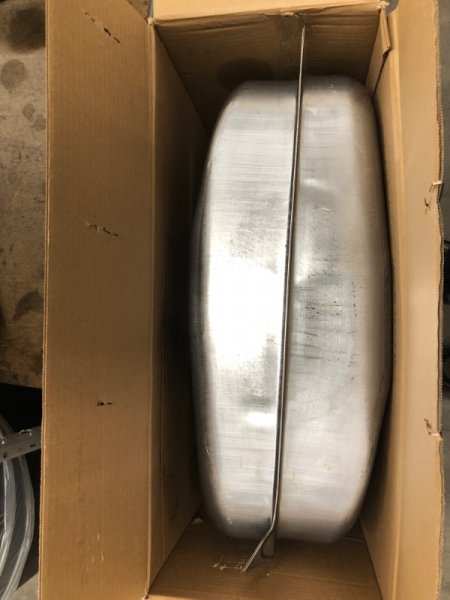
Option 1: get a slip yoke eliminator for the 231J (this is what I did) and a different driveshaft because the 231J with SYE is much shorter in length. I also found that I needed different u joint straps with the SYE I went with. Included are pictures of the box for part number reference.
Option 2: get a new rear driveshaft made that doesn’t collapse and just use the slip yoke in the transfer case.
Option 3: if the 231J and the Eagle transfer case are the same length, or close to it, you could get a “hack and tap” slip yoke eliminator. This would prevent the need for a new rear driveshaft.
Your front driveshaft can be reused in any of these cases.
The next thing to think about is the shifter. The biggest issue is that you sit pretty much right over the transfer case shifter. Again, you’ve got a few options.
Option 1: get a fancy cable operated shifter. I went this route and would go this route again in a heartbeat. JB custom fab was the place I got mine from and went for the flush mount one. This will require fairly substantial cutting of the floor if you get the same one I did. A picture is included.
Option 2: you could try to build your own linkage and use an existing 231J shifter. But then the shifter might not fit the floor very well and this will be fairly time consuming. The few I’ve seen that have done this method don’t look as clean, in my opinion. It just looks like a shifter sticking out of the floor with no bezel or anything.
Option 3: shift it from underneath. Don’t do this, it’s sketchy. But if you have an 81-84, you could leave the transfer case in 4 high and then use the CAD to engage only the front axle, giving you 2wd and 4wd. You’d still need to shift into 4 low from underneath though.
If you’re not dead set on something like an NP231J, you may want to look at an NP228 or NP229, both of which can be found in 80s full-size Jeeps. These have the same dimensions as the Eagle transfer cases and you can still use your driveshafts and 4wd selector on the dash. You could probably even reuse the full size Jeeps low range shifter.
VIN: 2CCCK3856GB703110
Now back to the regularly scheduled program.
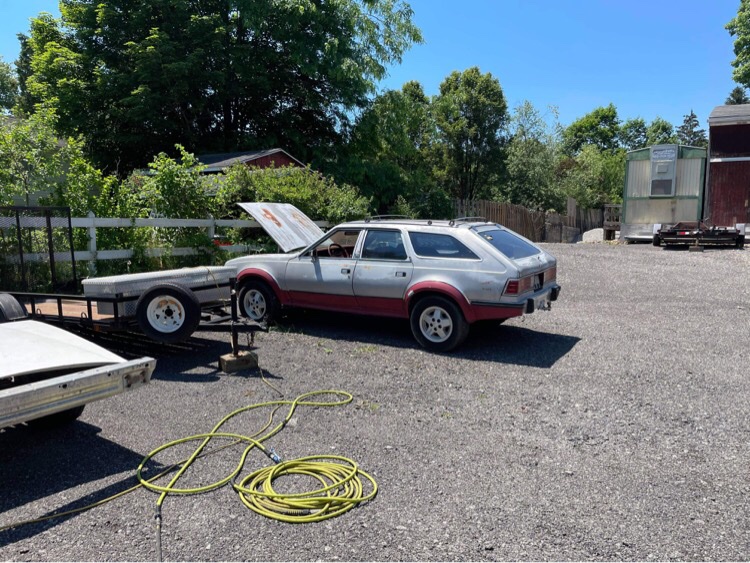
I have a long story with this car. It was given to me by my employer when I was 12. It needed a motor, so I bought a parts car and swapped the motor.
I then sold the car to buy my MJ. I don’t regret selling it for the MJ, but I had to jump on the opportunity to get it back.
Here is everything that I had done to the car along with pictures when I had it before.
1986 AMC Eagle Station Wagon
258 Inline Six
3-speed automatic transmission
Shift-on-the-fly transfer case
2:73 gears
106,000 miles on body
105,000 on engine from a 1985 Eagle
Rust free body from down south
Interior in good condition-a few tears in front seats, tiny hole in rear seat- about an inch in diameter
Spare front bumper, window trim, and transmission
New parts:
Axles
Starter solenoid
Vacuum lines
Spark plug wires
Heater hoses
Brake lines around master cylinder and on rear end
New fluids in transfer case, engine, master cylinder, and transmission
I have no idea how many extra parts are still with it, but the guy also said that he has a bunch of parts too