

gogmorgo
-
Posts
5984 -
Joined
-
Last visited
-
Days Won
4
Content Type
Profiles
Forums
Gallery
Everything posted by gogmorgo
-
Underside of drivers side carpet is wet
gogmorgo replied to Classy Comanche's topic in MJ Tech: Modification and Repairs
These guys are probably thinking that the glass is held in by the rubber trim. It used to be how most windows were held in. You do still see it on vehicles that have been in production for a long time, mostly heavy equipment, in which case if it’s leaking you’d probably need a new gasket. But that’s not the case with the Comanche. It’s just a normal piece of automotive glass that gets urethaned in place, just like the windsheild would be. Unless your glass is damaged you shouldn’t need new glass cut. What they’ll do is cut the old urethane holding it in, peel off any traces of the old urethane, clean up any metal or paint issues, run a new bead of urethane around the edge and set it back in place. The glass isn’t flat. So unless they’ve got real fancy equipment they won’t be able to reproduce it accurately. But if they know what they’re doing then they shouldn’t do any damage to the old glass. -
Front Shock Options for Stock Ride Height
gogmorgo replied to Salvagedcircuit's topic in MJ Tech: Modification and Repairs
I’d still be more concerned about how they react to you forcing them to move than their rebound time. And it doesn’t look like you had to push one harder than the other. Again how quickly or forcefully they push back isn’t really part of the design metrics unless they’re specially intended to support some of the load, which these aren’t. Their function is to resist movement, keeping spring oscillations in check. If you install the shock and do a bounce test on that corner, and you get more than a couple rebounds, then yes, the shock is bad. Even a little oil weepage on a shock that sees lots of movement (like on the gravel roads we have around here) isn’t enough to write off a shock so long as it’s still doing it’s job. That’s in the safety inspection books, and even Monroe themselves tell you that even though they make money selling replacements. But yes, it is unusual for them to rebound that slowly. If it fails the bounce test I would return just that shock for a replacement instead of trying some new and different product. The other one’s fine. Ordering two replacements is just doubling your chances of getting another single bad one. -
Engine Harness vs Engine Control Harness
gogmorgo replied to YNGFrankenstein's topic in MJ Tech: Modification and Repairs
Deleting connectors isn’t standard practise, but can be done without consequences (other than complicating disassembly) as long as you do it nicely. Usually it’s only done if there’s an issue with the connector pins, corrosion, melting, that sort of thing. But I won’t even attempt to get into a previous owner’s headspace… sometimes it’s better not to ask questions you don’t want an answer to. Unless the thing is completely butchered I wouldn’t be too concerned about just splicing the new engine control harness directly into the existing wiring. Solder and double-wall heat shrink tubing are your friends. You might even be able to track down new connectors if you really want to. -
Underside of drivers side carpet is wet
gogmorgo replied to Classy Comanche's topic in MJ Tech: Modification and Repairs
If it’s leaking then either the bond between urethane and paint (or glass) has failed, in which case there’s a strong chance it will continue failing and the window will fall right out, or else the paint/metal has failed, and there’s rust happening. RTV will not hold your window in, and it will create a rust trap that will cause you bigger problems down the road. Temporary fixes that work will become permanent, and this is not one you want to have that happen to. If mitigating it as you’re doing with a rag is working, that’s going to be a better temporary solution than half-assing a repair. Pair it with the dessicant packs if it’s going to be a longer term thing. For someone who knows what they’re doing, cutting the window out and gluing it back in will be quick and easy. A reasonable glass shop will also sand down and primer any rust spots that exist. It shouldn’t cost you too much, and then you’ll know the problem is fixed. -
Front Shock Options for Stock Ride Height
gogmorgo replied to Salvagedcircuit's topic in MJ Tech: Modification and Repairs
Well I’m not there and can’t argue with your impression of the shocks without having experienced it myself. But from my experience in changing dozens of shocks on a wide variety of vehicles with axle ratings between 400 and 40,000lbs, off the shelf shocks always seem to work just fine and yet always seem far more compressible than I expect them to be. It’s pretty rare to get one bad even out of an old beat to hell box covered in dust. I found one once that was obviously leaking from the oil all over the inside of the box that didn’t spring back, but that’s it. Again I can’t really argue with you but it seems like a heck of a coincidence you got that many bad shocks in a row. Not outside the realm of possibility I suppose but generally the simplest explanations are also the correct-est. -
Front Shock Options for Stock Ride Height
gogmorgo replied to Salvagedcircuit's topic in MJ Tech: Modification and Repairs
Are you doing something fancy with the truck? Other than some heavy duty stuff most shocks are very compressible right out of the box. Like Eagle said, they aren’t usually intended to carry load, just to control compression and extension of the spring. With a gas shock you expect it to rebound after you compress it. A high-performance or heavy duty shock will be firmer under compression than a typical passenger car shock because more control is better or you need more resistance for higher suspension force. Their primary function is preventing the spring from oscillating, by resisting motion. You can get into fancier stuff with performance shocks, different valving for compression and extension, or slow or quick movement. But for just a regular off the shelf replacement passenger vehicle shock for a lightweight vehicle like a Comanche, you’re going to be able to compress it fairly easily. -
Underside of drivers side carpet is wet
gogmorgo replied to Classy Comanche's topic in MJ Tech: Modification and Repairs
There’s a rubber gasket that goes around the outside. It’s not necessary to the function, just a trim piece. You can usually get away with reusing, although if they sit out in the sun they can get hard and difficult to work with, like anything else made of rubber. -
Underside of drivers side carpet is wet
gogmorgo replied to Classy Comanche's topic in MJ Tech: Modification and Repairs
No. Putting a “temporary” dollop is a good way to trap water and then rust. The only fix is to cut it out, address any metal issues, and glue it back in. Talk to a local glass shop, it shouldn’t be expensive. You might even find you can just gently push the glass out all the way of the adhesive has failed badly enough, then it’s just a case of peeling off the remaining adhesive, running a bead of windsheild urethane around the outside, and setting it back on (with tape to hold it up) although it’s maybe not the best idea to attempt it unsupervised if you don’t have auto glass experience. For the time being, get a desiccant pack to toss under the seat. Should be able to get at a hardware store, maybe even a larger better stocked grocery store. They sell them for controlling moisture and odours in closets, safes, etc. Some of them can be “recharged” by baking in the oven for a bit. Honestly it’s a good idea even if you don’t have a leak problem. I tossed a one under each seat in the ZJ and quit having the inside of the windows frost up on me in the winter. -

-

-

-

-
But you don’t get to speak for anyone else. That’s the point. It’s someone else’s name. No one it doesn’t belong to should be using it to make a buck, and that’s all that’s happening here. It’s a thing that was done, no one is trying to peel badges off or rewrite history. But it’s good to acknowledge it’s a thing that should not have been done, and moving forward we need to be more respectful of other cultures.
-
Yes. And it’s not wrong. Imagine if someone with no connection to you had taken your name and used it to help sell things that have nothing to do with you. Now imagine that someone was part of a group of people who pushed you out of your ancestral home and destroyed nearly everything your people had ever built, directly or indirectly killed your family, and tried to erase your culture. I wouldn’t be too happy with those people either. Some will argue it’s honouring the name and culture, but that’s not really for us to decide. I’m not indigenous and can’t speak for anyone who is. Some care more than others, some don’t care at all. To my knowledge no one is out there demanding badges be peeled off. But it’s not AMC’s name to use and they shouldn’t have used it, treating the name of a proud nation and history like an inanimate object. The Cherokee nation has repeatedly asked Jeep’s parent company to quit using the Cherokee brand, and every single time they’ve refused. Jeep isn’t currently selling much if anything under the Comanche name right now, but I can’t imagine it wouldn’t be eliciting the same response from the proper owners of the name. It’s hard to think something could really be an honour if the people you say you’re honouring repeatedly ask you to stop, and you don’t.
-
Front brakes won't bleed. Help me my friends!
gogmorgo replied to MishapMaggie's topic in MJ Tech: Modification and Repairs
I think you may be over complicating the bleed sequence and doing it a little out of order. Start by cracking the front bleeder, then bleed the rears. Close the front bleeder, bleed the rears again, then the fronts. If you don’t have the rear brakes fully bled before trying to bleed the fronts the emergency bypass will do strange things. Just to confirm, this is the correct orientation of the weight/height sensing proportioning valve: If you don’t have the rod going down to the diff, you can tie the bar up in more or less that position, pointing at the passenger side and a little above horizontal. It’s not unusual to find the two flipped over centre with the rod sideways and the flat bar pointing downwards, or the rod might be missing completely with the flat bar dangling. If that’s the case you won’t get much braking power at all from the rears, and it may also affect bleeding. As Eagle points out, light but steady pressure is best for bleeding. Think just enough pressure to hold an automatic in place while you’re in gear on flat ground. Hold pressure on the pedal, crack the bleeder, let the pedal sink while maintaining the pressure on it, and close the bleeder again just before the pedal hits the floor. I like to watch the air bubbles coming out of the bleeder and close it while they’re still moving. When I’ve been on my own without access to a vacuum bleeder I’ll make sure to use a hose with a tight fit on the bleeder and run a few inches straight up off of it, possibly with a couple loops before going into the container. I’ll leave the bleeder open and pump the pedal slowly a bunch until there’s clean fluid. Bonus if your hose reaches far enough you can see the bubbles in it. This doesn’t get a perfect bleed, but it’s generally going to be good enough to get around until you can do it properly. Also critical, don’t let the master cylinder drop too low while bleeding. If you suck air in, you need to start all over again. Failing all this, there’s another recent thread about brake bleeding. Among other issues, the master cylinder and booster had been replaced and the push rod hadn’t been adjusted correctly out of the box or something. Hopefully you’re not too close to the any of the fires, and your air isn’t too bad. Doing anything outside in the smoke is not a good time.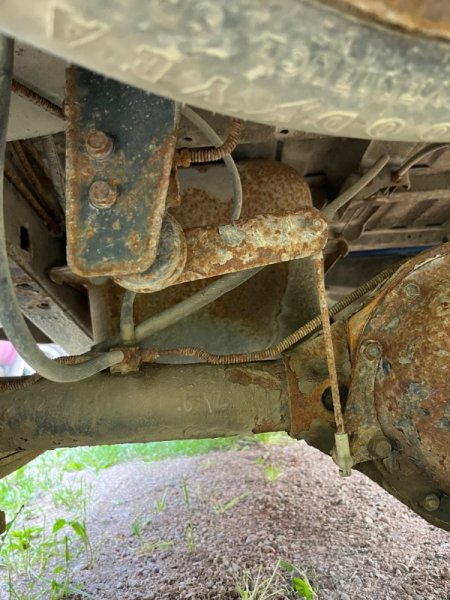
-
Yeah I don’t have much to say about the slider setup. Seems unnecessarily complex and I don’t really see it constraining a steer axle enough for safe street use, but then I don’t think any front leaf setup actually does that so… ¯\_(ツ)_/¯ You do see sliders used for trailer leaf springs, but they’ve got teflon bushings and stuff that sit directly on the sliding springs, in a channel where the spring’s not going anywhere else. That pin in a slot thing looks like an accident waiting to happen.
-
I’ve seen a couple that have had a YJ leaf setup put under the front. Not entirely certain why, but it’s a thing. Generally there’s a normal spring shackle at the front end though, rather than this slider setup at the back.
-
-
Saw a two-tone brown MJ somewhere near the airport in Winnipeg this weekend. There’s a few out there still.
-
There was another thread not too long ago where I dug up the circuit diagram. I think ideally you’d be putting it between the speed selector switch and the resistor pack, but you’d need an individual relay for every fan speed I think. Otherwise I would say the next best place would be just ahead of the hvac controls.
-
Dang. I gotta get this thing back on the road. Just fired it up for the first time in six months to mow around it… the a/c still works! I'm pretty sure it’s still got r12 in it even. I’ve been sweating my @$$ off in cars with no a/c for the last five years with this thing just sitting here?
-
Should be. Talk to your insurance company? Rebuilt means it was written off and then repaired. Usually there’s an inspection process of some kind. There’s also other title statuses for writeoffs that haven’t officially been rebuilt, in my jurisdiction “salvageable” for cars that could be rebuilt. We also have an “irreparable” status for cars that can’t be rebuilt, either too extensively damaged or more often a second write-off, and most places have the same, just possibly use different words. Those generally can’t be repaired and registered or insured, but every jurisdiction has different rules.
-
If you’re trying to use the process to clear a rebuilt status off a title, that’s fraud. Whether it works out through the process or not, don’t do it. A rebuilt title shouldn’t stop you from registering a vehicle. The Vermont process is generally used when your own jurisdiction is going to be problematic in replacing a lost title.
-
What kind of differential is this?
gogmorgo replied to Rhys Chalmers's topic in MJ Tech: Modification and Repairs
Not really sure what to tell you there... it's literally how Jeep's Trac-lok limited slip works. Clutch packs between the side gears and carrier. Nothing unusual-looking compared to an open diff until you pull the side gears. Start watching from the ten-minute mark if it doesn't cue it up for you. -
What kind of differential is this?
gogmorgo replied to Rhys Chalmers's topic in MJ Tech: Modification and Repairs
Not necessarily. Some diffs put the clutch packs between the spider gears and carrier, often only on one side of the carrier. It’s maybe not the most effective solution to traction but it’s cheap. Same basic principal most selectable lockers use, just lock one side gear to the carrier. If the OP has both rear wheels off the ground and the driveshaft free spinning, and both rear wheels turn in the same direction, that’s a strong indication it’s a limited slip. As is the “square” cylindrical end to the carrier, like was pointed out above.