


Eagle
-
Posts
15698 -
Joined
-
Last visited
-
Days Won
27
Content Type
Profiles
Forums
Gallery
Everything posted by Eagle
-
I knew that, I was just testing you.
-
I don't think we're trying to be a tough crowd. Most of the members here are more than willing to offer advice and counsel, as well as explain what mistakes we've made in the past so new Comanche owners can avoid our past misdeeds. BUT ... in order to provide useful advice, it is first necessary to understand what the problem is. When the first post about a problem doesn't include photos, and uses words that can't possibly apply to the situation, it's very difficult to offer anything constructive. I've got some guesses as to what might have happened, but I won't offer advice based on guesses because I'll probably be wrong -- and that's not helpful. So, 88mancheman, please give us more details, and post some photos. Be sure to include photos of the big u-bolts holding the axle to the springs.
-
Heck, the spacing on an XJ axle is closer, and people have actually just bolted in XJ axles to get a quick spring-over conversion. Then they wonder why it rides and handles funny and the spring bushings wear out ...
-
As Minuit commented, the XJs and MJs are prewired to work with full gauges, all you need is a cluster out of a compatible year. Yours is an 86? So you need one with a mechanical speedometer -- they changed to an electronic speedometer in 1991. The speedometer cable connection to the actual speedometer changed in 1987, so the easiest for you would be a cluster out of an 84-86 XJ or an 86 MJ. You can also use a cluster from an 87-90 XJ or MJ, but you'll have to replace the speedometer cable with the newer type. There should be several discussions on here about swapping the cluster. Try a search.
-
Manche build with LS2
Eagle replied to Manchemark's topic in MJ Hardcore Tech: Epic Journeys to Greatness
Wait -- you're trying to tell us there's a Comanche under all that tubing? -
This post has been split off from another members post about gauges because one is for a stock truck and this one is about a custom installation.
-
The Rancho rear AAL is an almost full-length leaf, it's a good product, and it's reasonably priced. But ... don't pay attention to their lift specs. Rancho lists the same AAL for both the Comanche and the Cherokee, and they claim it will lift the vehicle 2-1/2 inches. But Cherokee springs sit flat, whereas Comanche springs start out with an arch. Years ago I called Rancho to ask about that. I spoke with an engineer, who went off and spoke with another engineer. When she came back on the line, she told me I was right and their catalog listing was wrong. It lifts an XJ 2-1/2", but it only lifts an MJ 1-1/2". Which, IMHO, is perfect for a budget boost, and a much better solution than playing with lift shackles.
-
What spindle is on the rear differential? I've never heard of one.
-
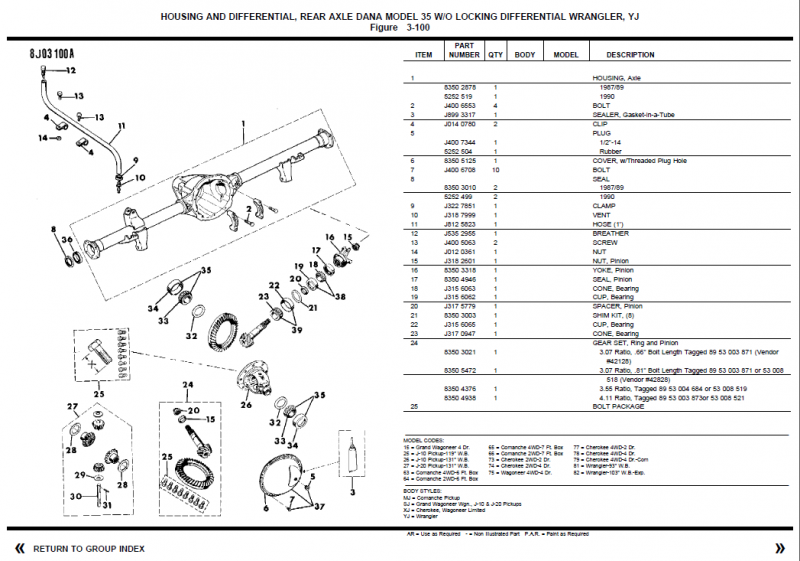
All possibilities, but there is no part associated with the rear driveshaft or differential that is called a "spindle," and there isn't anything that can "pull out of" the rear differential, so until the OP comes back and explains what happened we really are just guessing.
-
Without modification? 1987 thru 1990.
-
LOTS of Smoke Out of the Valve Cover
Eagle replied to bad_idea's topic in MJ Tech: Modification and Repairs
Yes, but witha PCV the valve itself gets plugged up. PCV valves are a routine replacement service item, but a lot of owners never touched them. -
Where are they rubbing, and what wheels are you using? 31x10.50-15s will fit with no trimming -- if you use stock Jeep factory wheels. The factory wheels have 5-1/4" backspacing. No aftermarket wheel has that much backspacing, so any aftermarket wheel puts the tires farther out, and that can cause problems. On stock rims, the only rubbing will be at full steering lock when the inside shoulder of the tire on the insode of the turn (left tire on a left turn) rubs the lower control arm. This can be addressed by shimming the steering stop, teaching yourself not to turn the steering wheel all the way to full lock, or switching to WJ Grand Cherokee lower control arms, which have a built-in bend to accommodate that issue. I was reluctant to try shimming the steering stops because I was afraid they'd break, so I just learned to not turn the wheel to full lock.
-
LOTS of Smoke Out of the Valve Cover
Eagle replied to bad_idea's topic in MJ Tech: Modification and Repairs
No, the 4.0L has a CCV tube, the 2.5L has a PVC valve sitting on top of the valve cover. Check to see if the PCV valve is open or clogged. -
LOTS of Smoke Out of the Valve Cover
Eagle replied to bad_idea's topic in MJ Tech: Modification and Repairs
Never assume. Guesses are good for deciding what to test first, but don't spend money on repairs until you know what you're repairing. If you suspect blow-by, the first test should be a compression test. Remember that all engines have some blow-by, and the Reniix 4.0L engines are known for having the CCV tube get clogged. When that happens, even normal blowby over-pressurizes the crankcase, and that's when you get oil dripping out of the smog tube into the air filter. You may only need to replace the CCV tubing and clean out the valve cover, but the first step is a compression test. -
-
If he has a light, he doesn't have a gauge. But if the light isn't coming on, what reason is there to think that it's getting "super hot"?
-
I am well aware of what can happen when a u-joint fails. However, the OP wrote that Since everything at the differential end is bolted together, there is nothing that can "slip out." Before we can offer any advice, we need to properly understand what happened ... and I cannot figure out what happened from the description provided.
-
We need photos, and I'd also like to know if the axle in the truck is the original axle. Whatever happened, it doesn't sound good, but your post left me feeling more than a little confused. I don't know what you mean by "spindle," but there's no part of the drive shaft that can pull out of the rear differential. The yoke is attached to the pinion gear by a nut, and the driveshaft is attached to the pinion yoke by straps with nuts on them. The axle sits on the leaf springs with mounting pads that are flat on the bottom and welded to the axle tubes. Even if the u-bolts were loose, I don't see how that could be loose enough to allow the axle to rotate far enough for something to pull apart without the big axle u-bolts falling off.
-
Death wobble is trying to come back
Eagle replied to Knucklehead97's topic in MJ Tech: Modification and Repairs
Factory spec for caster is +7 to +8 degrees, but 6 may be the best you can do with a lift because of U-joint angles. I'd say it's marginal. Factory spec for toe is zero, plus-or-minus 1/32 for each side, so it shouldn't be more than 1/16 toe-in. But I don't think 1/8" of toe-in would be enough to create any problems other than a bit of premature wear on the outer shoulders of the tires. -
Death wobble is trying to come back
Eagle replied to Knucklehead97's topic in MJ Tech: Modification and Repairs
10-4. My buddy at the VW shop uses a Hunter Road Force machine. -
This post has been split off from the discussion of Knucklehead97's death wobble because it has nothing to do with that topic of discussion.
-
Death wobble is trying to come back
Eagle replied to Knucklehead97's topic in MJ Tech: Modification and Repairs
No. As proven by my driving my '88 XJ all winter with a VERY loose track bar and zero death wobble. -
Topic split to avoid confusion.
-
Death wobble is trying to come back
Eagle replied to Knucklehead97's topic in MJ Tech: Modification and Repairs
But ... If he's been driving on these tires for several months, they're not brand new. If the tires are brand new, then my comments about tire balance apply. Also, was the alignment done at the same time the tires were installed? Basically, Knucklehead, you have been driving with no problems for several months. Now you have death wobble. What changed recently? That's where to start looking. When was the alignment done? Several months ago, or just a short time before the death wobble made its appearance? Death wobble is a complex issue. After all the years Jeep was making solid axle vehicles, you'd think they had it figured out. But ... when the 1999 WJ Grand Cherokee came out, it had a problem with death wobble. The problem only affected the European models, with export suspension. The difference between the Euro vehicles and the American vehicles was the durometer (hardness) of the rubber bushings in the front suspension. (I assume this referred to the upper and lower control arms.) One of the usual "causes" cited for death wobble is loose joints, including the track bar. But with my original '88 XJ, the original track bar eventually got so sloppy that I had nearly a quarter turn of "slop" at the steering wheel. It was winter here in New England, we had a lot of snow that year, and I didn't have an indoor garage to work in. So I drove it like that for a period of several months. I experienced no death wobble. So I don't accept that loose joints "cause" death wobble. They probably make it more exciting if it happens, but they don't cause it. Death wobble occurs when an imbalance in one front wheel is transmitted to the other front wheel, and the other front wheel then begins to wobble/shimmy at the same frequency. With both wheels wobbling at the same frequency, they enter into a harmonic where each wobble of one wheel amplifies the wobble in the opposing wheel. That's what death wobble is, and that's what differentiates it from simple wheel shimmy that's not reflected at the opposing wheel. Sloppy TREs don't transmit wobble from one wheel to the other. In fact, they would tend to allow a certain amount of wobble to occur before reaching an amplitude that would transmit back through the steering linkage. An automotive tire/wheel assembly is a gyroscope. If it's properly balanced, it should be very difficult to make it wobble, and the faster it spins the more difficult it becomes to make it wobble. For that reason alone I always look first to wheel balance as being the underlying cause of any death wobble incident. Other things, sich as worn steering components, may contribute by allowing it to escalate, but they aren't the cause. What were the alignment specs? Caster angle is crucial because caster helps resist/dampen wheel wobble -- did you set caster angle? If so, what did you set it to? If not -- what is it? -
Death wobble is trying to come back
Eagle replied to Knucklehead97's topic in MJ Tech: Modification and Repairs
You drove it for 30 miles with death wobble? I respectfully submit that I do not think you had death wobble. I have had death wobble. Once would be enough for anyone, and there is NO WAY I could have driven for 30 miles with what I had. There was no way I could have driven ONE mile. I was, literally, scared to death. It was all I could do to keep it on the road long enough to slow down to under 5 MPH to end the death wobble. After that, until I got it home and swapped tires, I kept it under 40 or 45 MPH.