


Eagle
-
Posts
15698 -
Joined
-
Last visited
-
Days Won
27
Content Type
Profiles
Forums
Gallery
Everything posted by Eagle
-
I have come into possession of a Samsung Tab something tablet. It's Android, of course, and I know nothing about Android. My cell phone is a Galaxy S3 on Android, but I use it as a phone - I've never explored apps, so I know less than nothing about the Android system. What I would like to do with this tablet is to copy the PDF files of all the building codes I freqntly refer to onto the tablet so I can carry that rather than about fifty pounds of code books when I go to sites or clients' facilities. The tablet has an app that apparently is a file manager, but it doesn't look at all like Windows File Explorer. What I need to know is: can I make new directories to put these files in, and can I make subdirectories under those new directories ("folders")? And can I then create screen icons to launch each file? If this is possible -- how can I do it? Thanks
-
My addiction was caffeine. I gave up smoking long ago enough that I absolutely don't miss it, but I cannot tolerate second-hand cigarette smoke. One whiff about makes me puke. But then came caffeine. I stopped drinking coffee when I was around 35, and that worked for awhile, until one summer I was working a project that was a 100-mile trip each way, and I made multiple stops enroute to fill up a new, large size Diet Coke. It got to where I told people my Jeeps were fueled by Diet Coke. And then, at 70 years of age, came the heart operation followed by severe atrial fibrilation (wacky heartbeat, in layman's terms). My cardiologist laid down the law -- no more caffeine. So I quit. These days, if I feel the need for a cola drink I have to get non-caffeine varieties. Too bad for McDonald's -- Burger King has caffeine-free Diet Coke, but Mickey D's doesn't. The worst part about no caffeine is that chocolate (the fourth major food group) contains caffeine -- the darker the chocolate, the more caffeine. At one point I asked the cardiologist if I really had to avoid chocolate. He said "Well, there isn't a lot of caffeine in chocolate. The only way to know is to try it." So I ate a couple of Hershey's Kisses. Two days later I was in the hospital for a cardioversion (That's electric shock to jolt the heart back to a normal rhythm. It's -- not fun. It takes a couple of weeks for the burn marks to fade away.) Okay, then -- no more chocolate. As John Wayne said, "A man's gotta do what a man's gotta do." Good work, Don. Stay the course.
-
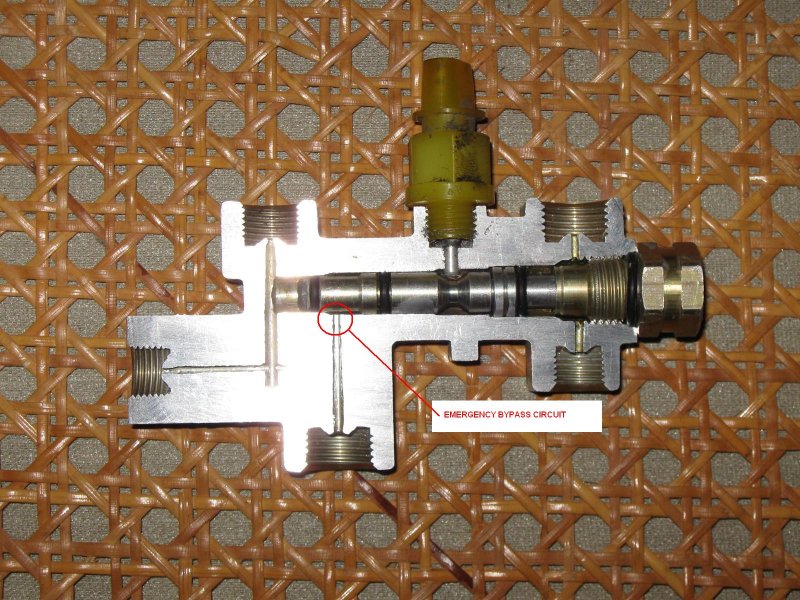
Yes. The one labeled "Emergency Bypass Circuit"
-
That, plus plug the bottom forward outlet on the front brake distribution block (multifunction valve body).
-
Check for a broken leaf ...
-
Spinning tires in rain comes with the turf -- a pickup has very little weight over the rear axle unless you're carrying a load. But getting wheel hop in the rain takes special talent -- the tires shouldn't hook up enough to cause hop, they should just spin.
-
What Rear End Should I Go With?
Eagle replied to jthoward8's topic in MJ Tech: Modification and Repairs
Doing the job is what counts. And if you're in a hurry, if I read the Tractor Supply web site correctly, most stores will have them in stock. The Mopar parts have to be ordered, even if you go to a dealer. -
The direct answer is "No." I haven't encountered wheel hop because I don't drive with a lead foot. That said, if you are experiencing wheel hop, all leaf spring vehicles function the same way, and traction bars will alleviate the problem. The next question is to figure out what type of traction control to get. The strongest and most effective are ladder bars, such as used on drag race cars, but those are probably overkill for an MJ driven on the street.
-
What Rear End Should I Go With?
Eagle replied to jthoward8's topic in MJ Tech: Modification and Repairs
3 bucks? What I found on their web site ate 15 bucks a pair, which is half again the price of the Mopar Performance units and not as nicely made. https://www.tractorsupply.com/tsc/product/carry-on-trailer-weld-on-spring-seats-3-500-lb-capacity?cm_vc=-10005 Did I misss something, or have prices skyrocketed since you bought yours? -
What Rear End Should I Go With?
Eagle replied to jthoward8's topic in MJ Tech: Modification and Repairs
The other drawback to the Liberty axle is that it doesn't have leaf spring perches that you can just cut off and relocate -- with the Liberty axle you have to buy a set of perches on top of the cost of the axle. Not a huge expense if the Mopar Performance Catalog still has their perches, but aftermarket percehes are pricey. If you try to grind the old ones off the original axle, then you lose having that axle as a template to set up the new one. Yay! Mopar Performance does still offer their excellent leak spring perches, for a whopping $9.60 per PAIR! And they are sized to fit the tubes on the 8.25 axle, I think http://www.moparonlineperformance.com/product-p/p4120074.htm -
MJ Load Sensing Valve Delete Procedure
Eagle replied to HOrnbrod's topic in MJ Tech: Modification and Repairs
I don't have any idea what #2 and #5 refer to, but you do NOT use the bypass line to run the rear brakes, because it's a bypass line that only functions when the front brakes have completely failed. Are you keeping the MJ front distribution block, or replacing it with one out of a ZJ, XJ, or YJ? That makes a difference.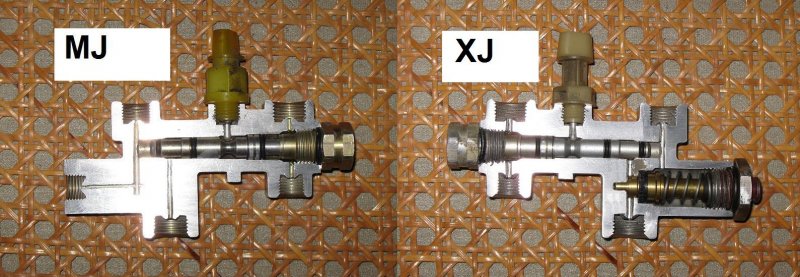
-
What Rear End Should I Go With?
Eagle replied to jthoward8's topic in MJ Tech: Modification and Repairs
Are you certain that it has 4.10 gears? If it's a 2.5L 4-speed, it should have 3.55 gears. The 4.10s were used with the 5-speed 2.5L MJs. To be honest, since it's a 2WD and you don't have to worry about matching ratios between front and rear, it would be much less expensive to just buy a Chrysler 8.25 rear axle out of a 92 or newer 4.0L Cherokee with automatic. That will be the correct 3.55 ratio for your engine and transmission setup, it's a stronger axle that the Dana 35 that is probably what you have now, and you can buy a junkyard axle for a lot less than the cost of a set of gears, bearings, and setup. You will need to relocate the spring perches, but the existing ones can be cut off and welded into the correct location using your old axle as a setup template. The best cheap axle swap is a 97 or newer XJ Chrysler 8.25, but for a 2.5L even the older 8.25 will be better than the Dana 35. -
If you want to use the 96 engine and ignition/injection system, you need everything from the '96. The XJ (Cherokee) and MJ (Comanche) underwent a total revision from 1990 to 1991. Up to 1990 they used the AMC/Renault/Bendix ("Renix") injection and ignition system. Starting in model year 1991, they switched over to a completely different, Chrysler-engineered ignition and injection system. There's an old saying, "In for a penny, in for a pound." Once you say you want to update, you have to update everything. So you will have to strip out the entire wiring harness, in the engine room and under the dashboard, and swap in the harness from the '96 donor vehicle. The brake and taillights on XJs work differently from the way they work on the MJ, so you'll need to retain the MJ taillight wiring and make an adapter splice somewhere near the back of the cab.
-
The XJs with 4 cyl and 4.56 were using the 904 3-speed tranny, not the AW4 with overdrive. Now that I think about it, I have no idea what ratio the factory used with the 2.5L and AW4 combinatuion.
-
So what's left if you unscrew the quick disconnect -- a conventional flare fitting?
-
Electrolysis for rust removal
Eagle replied to Manche757's topic in MJ Tech: Modification and Repairs
I don't remember which is which, anode or cathode, either, but it seems to me that both of the videos have it wrong. They both refer to the submerged rebar as the "sacrificial" element, but it's not sacrificing anything. It's being "plated" with ... rust. It's attracting the iron oxide from the rusty parts. In your case, if you used powdered zinc sulphate, how did you make your electrical connections? And what was the purpose of the Karo syrup and vinegar? -
Electrolysis for rust removal
Eagle replied to Manche757's topic in MJ Tech: Modification and Repairs
The water is dirty, but the sludge is just iron. Dumping it on the ground isn't really any different than taking a rusty part outside and chipping/scraping/brushing the rust off. (I think). -
Electrolysis for rust removal
Eagle replied to Manche757's topic in MJ Tech: Modification and Repairs
Somewhere on Youtube there is (or was) a series of videos by a guy who came into possession of a VERY old Colt 1911 pistol that had been buried for about fifty years. He used electrolysis to de-rust it and get it back to where he was actually able to shoot it. It wasn't a thing of beauty, but from what it looked like when it wsas dug up you would never have thought it would function again -- ever. In fact -- it looks like there are two series on such projects: https://youtu.be/B28_VN8Q6YE https://www.youtube.com/watch?v=bDM69iNaI_8 -
But he can't engage cruise, and the SET button is on the left. Is it possible that the brake switch isn't adjusted correctly, and you can't engage cruise because the "brain" thinks the brakes are on?
-
As my signature indicates (I think), one of the MJs I currently own is a 1988 2WD SporTruck 2.5L 4-speed. It has been off the road for a long time because it blew the clutch slave cylinder and had too much else on my plate to repair it. The body seems to be basically sound -- haven't crawled underneath to fully assess the condition underneath, but I expect it to be salvageable. I'd like to put it back on the road and do some upgrades, but I'm severely conflicted over what direction to take regarding power train. Which way would you go ... and why? My options are: Replace the clutch and slave cylinder and keep it as a 2WD 4-speed. I have a complete AX-5 and transfer case from an '88 2.5L, so I could replace the clutch, and swap the tranny and transfer case to make it 4WD. I have all the parts, including the bell housing, to convert the 2.5L to an AW4. That would go 4WD. I also have a complete '87 XJ 4.0L 4WD AW4 drive train, so I could convert to a complete 4.0L automatic setup. It's currently sitting on a 3.54 rear axle. I have a couple of 3.54 front axles, I have front and rear MJ axles in 3.73, and I have an '86 XJ 2.5L sitting on 4.10 axles. What would you do?
-
My friend did his outside in the driveway. Let's face it -- you're not building a NASCAR Grand National. Clean is good, but it doesn't have to be operating room sterile to run. I did one many years ago in my brother's hay field.
-
I need to start unloading "stuff." I came across the factory service manual for my 1993 Honda Accord. The car was sold almost 20 years ago, but the buyer was an effete intellectual snob, prep school teacher type so I didn't mention that I had a FSM. I'm going to put it up on Craig's List -- what's a fair price for it? It's in like-new condition.
-
A friend and cross-town neighbor just blew a piston in his 2.5L Wrangler. He bought a set of new Sealed Power pistons and rings, dropped the pan, and just replaced all the pistons. He didn't even hone the cylinders, just used a ridge reamer to clean away the carbon ridge at the top. You could do the same job, but in your case I think a light hone in the cylinders after cutting the ridge might be in order. Not trying to remove material, just to clean up the bores and leave a very fire tooth pattern to help the new rings seal.
-
The factory service manual shows the height to the top of the roof as 63.7" for 2WD and 64.7" for 4WD. The track is specified at 57" with 6" wheels and 58" with 7" wheels. If you go with the 8" Wrangler wheels you should pick up another half inch (not a full inch, because they have more backspacing), or 1" with 1/4" spacers. So let's say we can get your track to 59". You need to lower the roofline by 4.7" ... call it 5" to be safe. Setting aside whatever you can gain by installing 2WD 2.5L springs, what can you get from the tires alone. You can't go by the numbers calculated from the size, because when a tire is installed on a vehicle, the vehicle weight squashes the side that's in contact with the road. Most of the tire companies used to quote a number for that in their specs, called either "static radius" or "rolling radius." It's less than the theoretical radius, but there's no way to calculate it, because it's a function of weight and tire pressure. The spreadsheet I made up for NAXJA many years ago includes the static radius for representative tires in as many sizes as I could find data for, but I wasn't looking at anything smaller than a stock XJ/MJ tire. But, to give you an idea what the order of magnitude difference might be, let's look at a common XJ/MJ tire size: 225/75R15. The theoretical tire diameter is 28.3", so the theoretical radius is 14.15". But the number I have for actual static radius is 12.8" -- so that particular tire loses 1.35" due to sidewall squat. As you get into the lower profile tire series, there's just not as much sidewall there, so you won't have as big a difference between the theoretical radius and the actual, static radius. Just going by theoretical (calculated) dimensions, if you're starting with a 14" radius, and 7.5" of that is the wheel, that leaves you with 6.5" of sidewall. To get 5 inches out of that, you're down to a 1.5" sidewall. I don't think that's going to happen, so it's time to start looking at your springs.
-
According to JeepForum.com, the TJ Canyon wheels are: Canyon * 15x8 aluminum * 5 on 4.5" bolt pattern * Backspacing = 5.5" * Optional wheel with 30" tire package * Offset = +25 mm Be careful, because the ZJ Grand Cherokees had a wheel that looks almost identical, but it's only 15x7. Here's the 8" Wrangler version: