

AZJeff
-
Posts
1312 -
Joined
-
Last visited
-
Days Won
1
Content Type
Profiles
Forums
Gallery
Everything posted by AZJeff
-
When #6 is at TDC (verfied by copper wire into spark plug hole), the rods will spin, but not move radially at all (which should be normal, correct?)
-
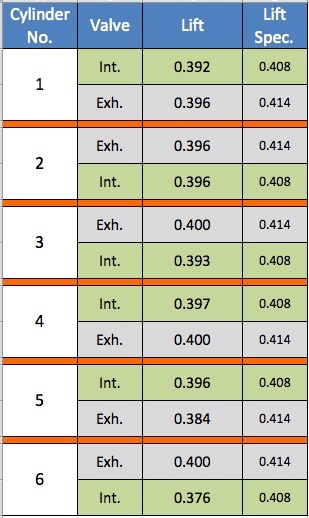
I acknowledge that I really don't know WHAT this engine is made from. I know it has the late intake, and had the late head (the 0331 that cracks when overheated), but the cam/crank/pistons may be a mish-mash of stuff, for all I know. I remeasured all the lifts again, and here is what I get:
.jpeg.8a775da55f247ad582b8365cc9127e9a.jpeg)
-
As my sig says, I have a 2000XJ engine/control system in my MJ, so the specs. I quote are for that year of engine (I have the Mopar shop manual for the 2000XJ). However, you are correct in that my noise seems to be eminating from around #6.
-
So I tried to measure valve lift at the valve spring retainer, but I could not get a good consistent spot with the tip of my dial indicator. So...back to a more complex, but consistent approach: 1. remove rocker bridge and the two rocker arms for a given cylinder 2. install dial indicator tip into hole on end of pushrod, and measure pushrod lift 3. multiply measured value above by 1.6 (the factory rocker arm ratio) to arrive at actual valve lift Here is what I came up with, and it's not pretty. Not a single pushrod lifts to the specified height, which means all the valves are not opening to the desired amount. Even if the lifters themselves are clean and functioning normally, I think my camshaft may be toast. Comments?
-
I used Mobile ONe in two XJ's I owned for many thousands of miles (here in PHX, the temperature endurance of synthetic is a significant bonus). I never saw any cam issues. Then again, I never had an engine with coolant contamination of the oil. I will pull the valve cover, and I will measure the lift on each pushrod with a dial indicator, and compare against the shop manual spec. I will report back in a day or so.
-
I did as you suggested, and recorded a cold start. Here is the video (mostly for audio value). As you can hear, there is virtually no ticking sound. Then I shut it down, and waited about one minute, and did a restart. The ticking starts up relatively soon after the restart, as you can hear. Cold Restart.m4v Cold Restart.m4v Cold Start.m4v
-
Mobile One 10w30 and a Mopar filter.
-
I will let it cool and try that, and advise. Thanks.
-
I get the idea of looking at the flex plate with my camera. Once the engine cools, I will dive into that. (Even though it never changes the noise between loading the engine versus no load.) But on the lifter inspection, what are you suggesting I will see? A pushrod flopping around under the rocker, or something else? Wouldn't that be most likely detected by looking for lash to return very shortly after the engine is shut off?
-
So I have added two short videos of the engine running (really all that is needed is the audio). The first one is after the engine had been at operating temperature on the road for about 20 minutes. The second one is of the engine on a hot restart after it sat for about 5 minutes after I shut it off from the 20 minute road trip. Hot Restart.m4v Hot Running.m4v
-
It’s an AW-4. I know the diff between a flywheel and a flexplate, and used the correct term. Besides which, I don’t think 4.0 flywheels crack around their mounting holes in normal use, unlike the flex plates☹️
-
I considered piston slap, as I had an XJ with some of that, but it slapped pretty much all the time at idle speeds. But let's rewind the tape a bit, and give the history of this engine: After purchasing the vehicle a few years ago, and spending about 11 months making it roadworthy, I took it for a shakedown cruise to a car show where my son lives, about 300 miles away. All went well. I had put fresh oil (10w30 Pennzoil) just before the trip. When I returned, I decided to change the oil. What came out was.....odd, sort of like a very thin pancake batter. I sent a sample off to Blackstone oil labs, and they confirmed my suspicion--I had coolant contamination in the oil. Knowing this was an engine from a 2001XJ that had been transplanted into my MJ, I did the recommended "0331 head" inspection, and found the classic crack in one of the rocker bosses on #4 cylinder by using UV light. So...off to Clearwater Cylinder head for a new head and valve parts. I also purchased new rockers, rocker pivots, and pushrods. WHen I disassembled the engine to install the new head, I noticed some signs of what caused the crack---some evidence of a previous cylinder head gasket failure and streaking of coolant down the manifold side of the block. I also noted the head gasket that I removed was NOT a Chrysler gasket, but was Fel-Pro. Someone had obviously been into the engine to deal with some sort of overheating failure previously, but was not aware that such an injury to a 1999-2001 "0331" head would almost certainly crack the head. I inherited that issue. When I did the new head, I also took all the lifters out and cleaned them in lacquer thinner on general principle, dropped the pan and installed a new RMS, and a new Melling oil pump, and cleaned the pan and put in a new one piece pan gasket. While I was down there, I dropped a rod cap to check the #6 rod bearing while I was doing the rear main. Except for a bit of dirt embedded in the shell, the bearing look ok, and not wiped in any way. I did NOT check clearances on the rod or the main. I checked for the classic signs of piston slap by turning the engine and watching for cocking of the piston skirt, and did not see any. The cylinder walls were perfect, and there was little to no carbon on the pistons, and no ridge on the cylinder walls. Once the engine was reassembled, the compression on all six cylinders was between 140 and 143 after an initial run-in. I figured all was well. The noise started up shortly after the new head was installed. I run Mobil One 10w30 with Mopar or Wix oil filters. The engine is smooth, with no shaking, no oil consumption, and no coolant losses. I am kind of mystified, as I would think that a sloppy piston would cause the compression readings to be a bit more varying. Input is still welcome.
-
OK, I did your suggested test. I waited until the engine was fully warm (where the noise is normally virtually gone), and I shut it off. Then I restarted it after about 10 seconds. The noise was unchanged, and was almost inaudible. I repeated the test, but instead of waiting 10 seconds, I waited about 1 minute. Upon restart, the noise appeared for about 3 seconds, and then disappeared. Lifter leak down? I found a video on YouTube of a guy with a TJ that has almost exactly the same noise/location, but he has not yet figured out what it is. Here is the link to his video (mostly useful as audio): TJ 4.0 Noise
-
I wondered about the lifters. I put a new head on it about 2 yrs ago (famous “0331” head crack) and put new pushrods/rockers on it, but just cleaned all the existing lifters in lacquer thinner and then soaked them in oil before reinstalling. I have a camera with a fiber optic. I wonder if I could see the crack in the flexplate somehow with that device....
-
It’s a 2000XJ engine, with OBD-2. It has new exhaust manifolds and the trick gasket some guys on here recommended (I cannot remember the brand name). The engine has the Calif. emissions package for a 2000XJ, so it sports two cats, one hanging off each bank of three cylinders. I have checked for cracks where the two cats join up to the exhaust pipe.
-
My 4.0 is making a strange ticking noise near the back of the engine, and it has a strange pattern to it. Let me describe the sound: it is not as metallic as a lifter, and it’s too. Low down in the engine to be valve train. It’s not as deep or dull as a main bearing knock. Engine load (or lack thereof) does not change the noise, so it’s not a rod issue. None the less it’s a sort of tapping sound, but with a temperature component I will describe below. When I first start the engine, the noise is not present. As the engine warms up, the ticking is audible, but only at idle. Once the engine comes even slightly off idle, it’s inaudible, and of course as engine speed increases, the general engine and road noise may be masking it. When the engine is FULLY warmed up (running for 20 minutes or more on the road), the noise is no longer audible at ANY engine speed. If I shut the (fully warmed) engine off and restart it within about 5 minutes or less, the noise remains gone. On the other hand, if I wait longer than 10-15 minutes and restart, the noise reappears again until the engine re-warms, at which time it disappears. Oil pressure is good (within spec.) and compression is uniform at 140 +/- 3psi on all six cylinders. My stethoscope investigation points to the noise being near the back of the block, but I cannot pinpoint it. Any suggestions?
-
A 4.0 cooling system will do an "acceptable" job of keeping the engine at normal (design) operating temperature, even with air conditioning, and even in extreme temperatures. I live in Phoenix, and have had three XJ's and MJ's that have successfully operated in a climate where daytime temperatures regularly go over 110*, and pavement temperatures are regularly above 140*. The key to a successful cooling system is one where ALL the OEM components are operating as designed, and therein lies the trick: many owners neglect little things like a worn viscous clutch fan, or a missing mechancial fan shroud, or a slightly degraded radiator. I have found the the following combination of OEM parts to be quite effective 1. regular water pump (and major brand is just fine, and there is no need to spend money on something fancy) 2. a fully functional viscous clutch 3. a proper fan shround 4. the electric cooling fan that was found on later model XJ's 5. a new EIGHTEEN pound pressure cap (on an open system) 6. a quality 195* thermostat I do deviate in one way from OEM parts---I run a CSF all-metal 3 row radiator. I cannot say if it works any BETTER than an OEM, but at least the plastic tanks won't degrade in our intense heat here.
-
I cannot explain why Jeep only used in selective places on th bell housing. However, the use on fenders, door hinges/strikers, etc. is obviously driven by those production line factors.
-
The Torx bit was developed by The Camcar division of Textron. It’s design is similar to that of a gear tooth (technically it’s an “involute spline”) and it spreads the fastener driving force over a larger area. The MAIN advantage is that the tools used to drive Torx fasteners last MUCH longer in a production line environment. So now you know....😉
-
Only Jeep would use machine screws to attach tailights 🙄 I switched to Torx head stainless steel #8 (I think) sheet metal screws and “j-nuts” to attach my taillights.
-
No, the trans throttle cable controls some of the fluid porting in the trans. When mine was out of adjustment, the trans would slip in and out of gear randomly at cruising speed, yet would accelerate fine.
-
How did you do the graphics? They look very OEM.👍 Suggestion: you need some black screws to hold on the bottom instrument panel cover to make it a bit more finished. If you cannot find any on Guam, let me know what size/length you need. I might have some I can send you.
-
The 97 Dakota tank holds 22gal., and fits quite nicely (with a small dent added to the tank to clear a chassis brace.)
-
I put in the reclining sport seats, with the optional lumbar support. I went with cloth, because leather is no real pleasant here in AZ in the summer. Thet are firm, with decent side support, but not hard to climb into on an MJ with a 3.5” lift. Wife does not complain (much).
-
I put a set of Corbeau seats in my MJ, and used their brackets as well. I had only one bolt hole I had to ream to get it to align with the stud in the floor. I am happy with the fit, and the comfort.