


Eagle
-
Posts
15698 -
Joined
-
Last visited
-
Days Won
27
Content Type
Profiles
Forums
Gallery
Everything posted by Eagle
-
'86 Would be an AMC Model 20.
-
Are you sure it was a '96? 1996 was the year the Cherokee first came with OBD2, which used a standard OBD2 'D' connector under the dashboard. 1995 was still OBD1.
-
Just eyeballing the difference between the front seat pedestals in the illustration I posted above, I'm going to guess the difference is an inch and a half to two inches.
-
The legendary 2.8 to 4.0 swap (Help Needed)
Eagle replied to Landoloops's topic in MJ Tech: Modification and Repairs
This thread is ELEVEN YEARS old. Closed! -
The only way to know what parts "must" be replaced is to check out each part. My 1988 Cherokee, which I bought new, has over 287,000 miles on the odometer. The only part that has been replaced that affects steering is the track bar. Ball joints, tie rod ends, drag link -- everything else is original, and the steering is tight.
-
That doesn't mean you can't use the seats out of an XJ with the rocking chair option, it just means a bit more ingenuity in mounting the XJ seats to the MJ seat pedestals.
-
VERY good point.
-
What is this in reference to? This thread is more than two YEARS old, and you have not participated in it. If you are having a problem, I suggest that you start your own thread, and begin by clearly stating what problem you have and what you have done so far to try to trouble-shoot it. I'm going to lock this thread. It has run its course.
-
AMC-era Cherokees had an option that, in addition to allowing the seat backs to recline, and allowed the seat bottom (and thus the entire seat) to tilt. Those seats have a second handle, one for the recliner/tilt and one for the base tilt. The base angle is changed by a curved slider under the seat pan, that's why we refer to them as "rocking chair" seats. If the seats have that option, bolting them directly into an MJ on the MJ seat pedestals results in a seat that's higher than the standard seating position. This may be okay for shorter drivers, but it doesn't work well for taller drivers.
-
You don't have voltage ... where? Did you read the entire thread above? Start be verifying whether or not you have voltage TO the switch. If so, jumper the contacts on the switch terminal and see if the backup lights wwork when the switch is bypassed by a jumper.
-
He can see what the rods and mains look like without any help from us. Your concern was the cam bearings, and if he's going to tear it down far enough to check those he's well into doing a rebuild. The OP asked for opinions. I offered my thoughts. Your thoughts are different from mine. That's life. If it runs now but has low (zero) oil pressure just at idle, I think it's worth throwing a set of bearings at it. If that doesn't work, he can still use those new bearings for a rebuild. Once he drops the pan, if the bearing journals are badly scored, then he'll know it's time for a rebuild, or a different engine.
-
An expedient field repair is generally worth a try before just assuming the engine is toast and tossing it. In the famous book The Grapes of Wrath, the Hudson pickup truck the Okie family was driving west lost a piston ring. The repaired it on the side of the road by dropping the pan, lowering the bad piston, installing a new ring, and (since they didn't have a ring compressor, and that wouldn't have worked from the bottom anyway) using a length of fine thread or soft copper wire (don't remember which) to compress the rings while they pushed the piston back up. Once the engine started, the thread or wire released from the heat and the ring seated. Yes, a work of fiction, but I don't think Steinbeck would have written that in such detail if he hadn't heard about the method from someone who had done it. I number of years ago I picked up a 6-cylinder Javelin with a frozen engine. I removed the head, soaked the pistons with oil, and knocked them loose with a mallet and a block of wood. I reamed off the carbon rings, honed the cylinders with the pistons in place, blew and wiped out the gook as well as possible and put it together. I drove it as a commuter car for about two years when I worked in a neighborhood where I didn't want to take a decent vehicle. More recently (about 6 weeks ago) a friend lost a piston in a '99 Wrangler with the 2.5L engine. Apparently that's a common ailment with the newer 2.5 liters. After driving it 15 miles with a broken piston, he pulled the head and pan, shoved the pistons and rods up through the bores, had new pistons put on the rods, and reassembled with new rod bearings. He didn't hone the cylinders, didn't even loosen the main bearing caps. It fired up and he said it runs stronger now than it did before the piston grenaded. The point is -- yes, if you're building an engine for a NASCAR cup racer, you do everything "right." But in the real world, when you don't have anything to lose by trying a field expediant, why not do it?
-
When bleeding by the pedal method, is the "pedalman" (for lack of a better term) pressing slowly, or is he pushing really hard? The shuttle shouldn't trip from bleeding brakes. I've never heard of that happening, so my first thought is that the pedalman is just pushing too hard. But -- one thing you might try is to reset the shuttle, leave the brake light switch out of the metering block, and have a second helper manually block the shuttle from moving by holding a piece of metal rod (perhaps the back end of a drill bit that matches the plunger hole diameter) against the "waist" of the shuttle while you and another assistant do the bleeding. Or stick a plunger substitute in there and hold it with a hose clamp.
-
Do the Cherokee seats have the "rocking chair" option, or not? The floor brackets are different between the XJ and the MJ, but it's not difficult to remove the seats from the XJ pedestals and mount them onto the MJ pedestals. The MJ bench and buckets use the same pedestals, except that the bench doesn't have an adjuster lever on the passenger side. The rockking chair option on the buckets complicates things a bit, but it's still possible.
-
The pan has to come off anyway (if it hasn't already). I would replace the bearings (rods and mains), button it up, and hope for the best. The fact that it will start and run is a good sign. When you open it up, before ordering the new bearings, examine all the bearing journals. If they aren't scored, I think you're safe to proceed. If they are slightly scored, you may be able to polish them up enough using crocus cloth. There's a bearing size code stamped into the side of the engine near the distributor. Check that before ordering. Don't assume that everything is standard. They probably are -- but don't bet the farm. While it's open, think about replacing the oil pump.
-
Nowhere in there did I get any understanding of how or when the shuttle valve in the front metering block tripped. How do you know it tripped? And, once it tripped, how dod you reset it?
-
rhollen - Please describe exactly how you bleed using the pedal procedure. Just had a thought why the shuttle valve may be tripping.
-
Yeah, but just think how nice those power windows will be in a daily driver ...
-
Battery over heating and dies after 4 kms
Eagle replied to Myles Cyncora's topic in MJ Tech: Modification and Repairs
Your buddy is completely wrong. Turn on the headlights. Are they nice and bright? If not, there's a bad connection or a bad battery. If the headlights are bright, leave them on and try the starter. Do the headlights go dim when the starter is engaged? -
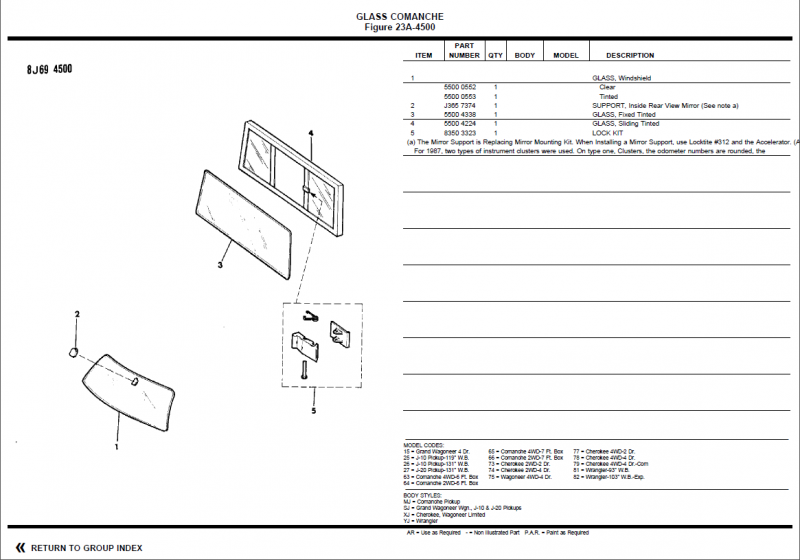
Windshields don't have frames. The newer Cherokees use a trim gasket that fits directly to the glass.
-
The one piece is glued in, like a windshield. There is no frame. The seal is the sealant/adhesive that holds it in -- the gasket is trim.
-
'91 was next to the last year for the MJ. It's an HO (betcha didn't know that, did you?). That's not "early" in XJ/MJ parlance.
-
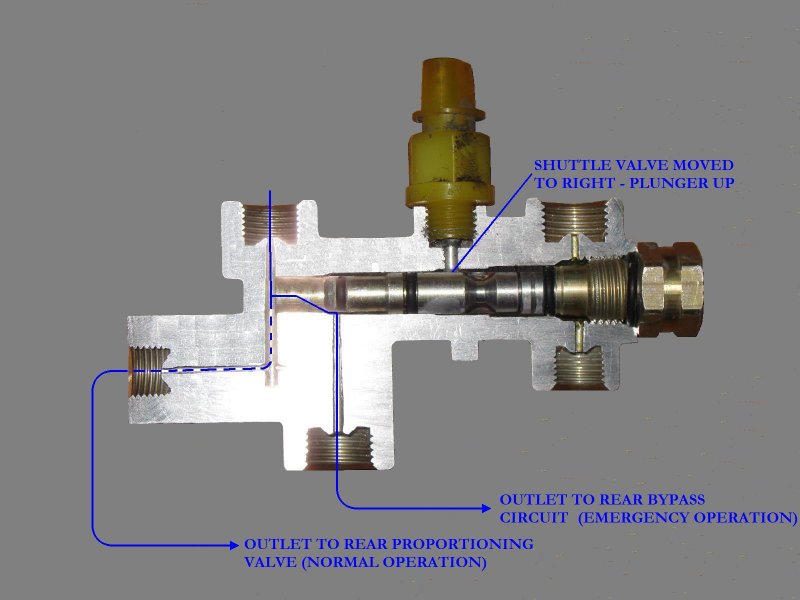
That front block in the MJ is NOT a proportioning valve, and it does not contain a plunger or spring. The XJ unit is a proportioning valve and meets this description, but not the MJ. All proportioning in the MJ is done by the rear load/height-sensing valve. The shuttle valve in the front metering block should not move if you vacuum bleed one wheel at a time. It also should not move bleeding by foot pressure unless you're pushing too hard and too fast. This is the MJ metering block, cut open (this shows it with the shuttle valve tripped, to open the rear brake bypass circuit):
-
The earlier ones didn't drop the condensate onto the top of the frame rail, the tube extended down over the side of the rail and discharged directly onto the ground. Chrysler's bean counters must have saved at least 1.37 cents per vehicle with that change.
-
Got it. Comes out of the evaporator housing about 2 inches and stops. Doesn't "go" anywhere, it just pees on top of the frame rail. Can't see it from underneath -- that was my erorr. It's right there when you look down from above.