

AnotherOldJeepGuy
-
Posts
860 -
Joined
-
Last visited
Content Type
Profiles
Forums
Gallery
Everything posted by AnotherOldJeepGuy
-

MayDay!! - Hard Accel Killed Idle
AnotherOldJeepGuy replied to AnotherOldJeepGuy's topic in MJ Tech: Modification and Repairs
For sure! I'll get out there in the morning before the Texas heat kicks it! -
MayDay!! - Hard Accel Killed Idle
AnotherOldJeepGuy replied to AnotherOldJeepGuy's topic in MJ Tech: Modification and Repairs
Probably put on another 15 miles today across a few smaller errand runs. No stall, no hesitation, idle not perfect but close. All local street driving so mostly 40-45 MPH with lots of starts and stops at traffic lights. EGR still disabled. I don't like this fix, it wasn't necessary to have the EGR disabled before so something is not quite right, but after close to 3 months of effort to get a 100% fix, I may be forced to accept this repair since it seems to be a working solution (knock-on-wood) with only a small band-aid. @Gojira94, you might be getting you loaner back before too much longer! -
MayDay!! - Hard Accel Killed Idle
AnotherOldJeepGuy replied to AnotherOldJeepGuy's topic in MJ Tech: Modification and Repairs
Sorry, I used the incorrect wording. I didn't "delete" the EGR, I "disabled" the EGR by capping off the control hose as noted in the pic. Since doing that I have driven around the area maybe 5 miles or so in basic traffic, no stalling, no sputtering or hesitation. This is only day 1 of this EGR Disable experiment, so not drawing any conclusions on my end, just noting how the first 5 miles went. -
MayDay!! - Hard Accel Killed Idle
AnotherOldJeepGuy replied to AnotherOldJeepGuy's topic in MJ Tech: Modification and Repairs
I don't see this happening much. At idle with AC off it I see 120-122 and it isn't moving constantly. With AC on it bumps up to 123-125, but in both cases it stays within a couple and is not jumping around. This is probably not what is meant by continues to rise of fall. I went back to the EGR delete config because I had notice back around May 21 that the EGR plunger moves sometimes at accel, and sometimes it doesn't. And I also noted at that time, when the plunger does not move, the stalling at 3%-5% throttle didn't happen, OR, it seemed to happened way less. Now that I have possibly corrected some issues, I decided to go back to this again and with minimal testing, I am not getting any attempted stall at 3%-5% throttle. The HAS to be a clue of some kind, ether the fact that the EGR only moves sometimes, or the relationship between it moving or not, and it stalling or not or both. So, I think I'll leave it like this for the moment and see how long it will continue to not stall. Also worth adding as a reminder (and for the folks that understandably don't want to go back and study the entirety of this very long diagnostic thread), shop #1 told me the EGR solenoid was bad and it has now been replaced. Why would the EGR move sometimes rather that always at initial throttle movement? It was previously noted here that the EGR "operates at part-throttle conditions", that sounds to me like it should be moving every time I hit the throttle not just sometimes. Of course if it did, I would stall almost everytime and that doesn't make things any better, but the question still seems valid.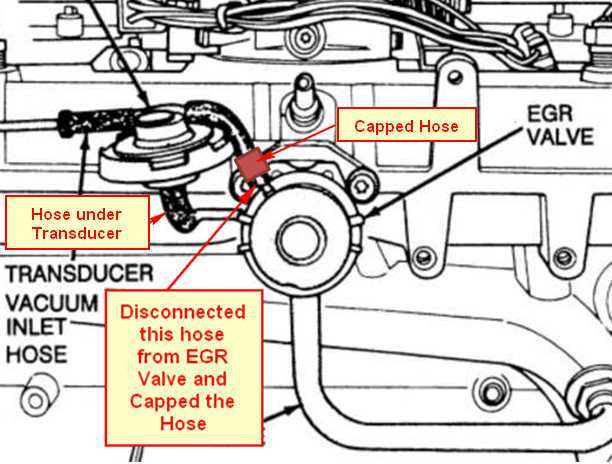
-
MayDay!! - Hard Accel Killed Idle
AnotherOldJeepGuy replied to AnotherOldJeepGuy's topic in MJ Tech: Modification and Repairs
Before pulling the new TPS I monitored it with the REM as I very gradually increased the throttle, and it seems to be working perfectly. See the video starting at about 11s, I increased from 0 to 100% throttle as consistently as I could, and I don't see how it could be working any better, as long as a linear response it expected. https://drive.google.com/file/d/1eOZWdCA8HX7o_pE6bi6GLOq3v5kk8PqL/view?usp=sharing I think I'll take a look around the web to see how to test my IAC. -
MayDay!! - Hard Accel Killed Idle
AnotherOldJeepGuy replied to AnotherOldJeepGuy's topic in MJ Tech: Modification and Repairs
Yeah might as well try the old TPS. I see that a new IAC is not very expensive so might try that also unless the TPS turns out to be a fix. -
MayDay!! - Hard Accel Killed Idle
AnotherOldJeepGuy replied to AnotherOldJeepGuy's topic in MJ Tech: Modification and Repairs
I went with video instead. This 43s video demonstrates the "want to stall" state a few times, the most noticeable instance near the end. https://drive.google.com/file/d/1FJgFQBm6sbe5DL0OHUJR9BRpVZYLkjcQ/view?usp=drive_link As a reminder, this video is the original before any of the work has been done, or at least before most of it had been done, https://drive.google.com/file/d/1y7lS4y-ZxsylCh9y-odN4-UIrnIeS3lh/view?usp=sharing -
MayDay!! - Hard Accel Killed Idle
AnotherOldJeepGuy replied to AnotherOldJeepGuy's topic in MJ Tech: Modification and Repairs
It does start fine and idles fine when I start it. It might cycle up/down at idle a tiny bit but it is not much. It's just when I advance the throttle just a smidge, it wants to stall, that's my guess at maybe a 3%-5% throttle. Once past that spot it seems to be running pretty well again, until I approach that same spot on decel, and when it gets down there it again wants to stall in that same small window, but if it get past that to 0 throttle without stalling, it goes back to idle without stalling. It's really that 3-5% spot right now that is problematic. I'll hook up the REM and see if I can identify an RPM range that is a problem and report back. I cleaned the TB and the IAC thoroughly maybe around 18 months ago, it was stalling when I came to idle at a stop sign or light. With this new issue I have inspected both to see if they were dirty again, but both are clean. In fact cleaning these is what fixed it at that time. Back 18 months ago when I was battling a stall, and before I cleaned the TB and IAC, I installed a new TPS because I had one. Nothing changed but I left the new one in. I kept the old one, I might put it back in just to see what happens. (I have adjusted TPS to 17% at idle based on REM reading). I did get 1 single small backfire earlier today as I took the throttle up and dropped it maybe a dozen times listening to hear anything useful. -
MayDay!! - Hard Accel Killed Idle
AnotherOldJeepGuy replied to AnotherOldJeepGuy's topic in MJ Tech: Modification and Repairs
See pics on 5/26 and 5/27 (page 5 of this discussion) for what the plugs looked like back then. The consensus was running rich. I cleaned them all and put them back in. Checked again on June 15 (page 9) after a lot of the work has been done and the couple I pulled that day (to allow me to do the index check) looked clean as far as I can tell, but you can tell me if you think differently? I don't know that I have the tool for checking compression but I can probably find one somewhere. It is idling pretty smooth now and other than the tendency to stall at maybe a 3%-5% throttle, the rest of the time engine seems to be running pretty well, would these other things you mentioned be an issue at minimal throttle but not be noticeable at idle and throttle above maybe 5%? -
MayDay!! - Hard Accel Killed Idle
AnotherOldJeepGuy replied to AnotherOldJeepGuy's topic in MJ Tech: Modification and Repairs
Got back from the shop with the new donut. First stall was before I left the shop . That seems to be the most noticeable issue with the engine right now. If I can keep it from stalling right at initial throttle, it runs. The tech used a tube in the ear to check for leaks at the new gasket and he was satisfied it was not leaking. It does sound better, a sign that perhaps the leak seen before at the donut is gone. I will repeat the air-vac bubble test later when it cools down. I did tell the mechanic about the other small bashful bubble leak I had seen off and on, his opinion was that if it was that small it should not cause any problem. However if I can find it my plan is to try to plug it with JB Weld. If it is really a pin hole and I can scrape it down to clean metal, JB weld should at least provide a temporary fix long enough to tell if it makes any difference. He put a small hole in the pipe near the cat and fished a stiff wire through to check for possible flow blockage. He said it seemed to him it was already vacant at this point and is essentially a straight pipe. The guy's a 30 year mechanic at a muffler shop, seems like he would know. I currently have the battery disconnected to do another ECU reset just in case it's off at the moment because it has not learned yet that the donut leak has been repaired. A Hail Mary I know, but easy to do. -
Dorman vacuum harnesses
AnotherOldJeepGuy replied to jodawill's topic in MJ Tech: Modification and Repairs
I have @pizzaman09's mod on my to do list as soon as I manage to rescue my truck from death row -
MayDay!! - Hard Accel Killed Idle
AnotherOldJeepGuy replied to AnotherOldJeepGuy's topic in MJ Tech: Modification and Repairs
Wellll, I talked to him about that and the answer was he can't do it, it's against federal law:(. So for the moment at least the cat stays. He did say he would do some kind of check by poking a hole in the pipe before and after the cat but I didn't really catch what that was going to do. The ride down to the shop was very noisy since I didn't bother to reattach the pipe at the donut since they were going to take it right apart anyway, the shop is only a couple miles away. Sounded like I was ready for the drag strip! -
MayDay!! - Hard Accel Killed Idle
AnotherOldJeepGuy replied to AnotherOldJeepGuy's topic in MJ Tech: Modification and Repairs
I hear ya and thanks! I've had this thing for too many years to give up! Got my new test case spark plug wires in the mail ($6 ebay) and put them on. I wanted to test the theory that different wires would not arc and it was worth $6 for that experiment. These plug are all the correct length (11" x4 and 13.5" x2) according to figure 8-5300 in the parts cat. All wires in place, no arcs I can see in the daylight and none heard. So my $6 set of wires may be all I need. They are all I need for now anyway. I'm taking it down to the muffler shop at close of business today so they can put it on the lift and let if cool off overnight and install the donut in the morning, and probably eliminate the cat but not 100% convinced of that yet. -
Dorman vacuum harnesses
AnotherOldJeepGuy replied to jodawill's topic in MJ Tech: Modification and Repairs
FWIW I have used zip ties at multiple locations for the same reason. -
MayDay!! - Hard Accel Killed Idle
AnotherOldJeepGuy replied to AnotherOldJeepGuy's topic in MJ Tech: Modification and Repairs
Well about 2 hours later and I am no where near to getting the old donut off . I did manage to get the bolts loose, that was fairly easy. And that allowed me to move the pipe enough to get some access to the donut. I thought I was on a roll and could knock the old gasket off, put a new one on and just maybe fix something. But I had no idea the old donut gasket would be made of of granite, or something about that hard! It had no interest at all in coming off. Decided the only chance I had was to remove the pipe to get it out of the way and give me as much room as possible to work, but I could not get the nuts loose just before the cat. So I guess I'll take it to the muffler shop this week and get them to do it. Probably have them straight pipe it to the muffler while they have it torn down that way if the cat is damaged and contributing to my issue, that will be gone also. The project continues... -
MayDay!! - Hard Accel Killed Idle
AnotherOldJeepGuy replied to AnotherOldJeepGuy's topic in MJ Tech: Modification and Repairs
The alternate bubble test approach suggested by @87MJTIM was useful. Back on May 31 I noted that the gasket at the bottom of the exhaust manifold where is connects to the next pipe was crumbly. At that time I did my version of the soap test which was to soap it up and start the engine. I did not see bubbles. But with the air up the tailpipe test, I saw lots of bubbles at this gasket . I don't understand really how it didn't blow bubbles the first time, but regardless of that it blew a lot of them today. I also saw a bubble in the general area of the red circle area below. This other bubble was very bashful, it didn't last and was difficult to recreate, I tried multiple times adding more soap and only occasionally I saw something. So it is there, but, it is also much less of a void compared to the gasket. I tried soap at as many other places as I could get to and didn't see any other bubbles. I'll try to replace the deteriorated gasket first and see what happens since that void is much more plentiful, and very close to the O sensor (although on the tailpipe side so i don't know how much it counts). I hope soaking the threads a few times with PB Blaster will let me get the bolts out. Worth noting, if I tried to put the shop-vac hose in to the point that it nearly sealed at the tailpipe there was a lot of push-back, and as soon as I let go it blew itself out. This tells me that there is no large leak. I could only put it in partially filling the tailpipe hole for it to stay there. That seems to be a good thing.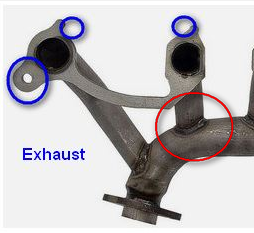
-
MayDay!! - Hard Accel Killed Idle
AnotherOldJeepGuy replied to AnotherOldJeepGuy's topic in MJ Tech: Modification and Repairs
I agree. There's nothing about my jeep-kill maneuver 2 months ago caused my plug wires to go bad. Over the last 2 months I have fixed or improved a hand full of things from a combination of my own snooping, inputs from two local shops, and lots of help from the group. None of them logically would result from the incident. However I have seen improvement, so the thought is the more things I improve, the fewer things are leading me away from the real problem, and also that once that is fixed, all these things along the way were still needed if not as repair then as maintenance. The plug/wire discussion has for sure gone down a rabbit hole, mostly because I don't know what I don't know, so lots of question! It would appear 4 of my 6 wires wore out quickly, or were defective from the start. https://drive.google.com/file/d/1xcfAGNxF7kxNITGvatwoXsNuFASuBCHK/view?usp=drive_link Does this combination of plugs/wires pass the test?: https://www.summitracing.com/parts/cpn-404 https://www.summitracing.com/parts/tay-51048 -
MayDay!! - Hard Accel Killed Idle
AnotherOldJeepGuy replied to AnotherOldJeepGuy's topic in MJ Tech: Modification and Repairs
Interesting. I have been trying the bubble test but have been doing in letting the motor as the bubble blower. But my version only gives about 1 minute before the metal gets hot and evaporates the liquid. This seems like a good experiment to try. -
MayDay!! - Hard Accel Killed Idle
AnotherOldJeepGuy replied to AnotherOldJeepGuy's topic in MJ Tech: Modification and Repairs
So are you suggesting that if I replace the plugs I would no long have arcing? Adding to Question. My owner manual and my Haynes manual both call for Champion RC9YC, is that also a compatible plug for the wires I have? -
MayDay!! - Hard Accel Killed Idle
AnotherOldJeepGuy replied to AnotherOldJeepGuy's topic in MJ Tech: Modification and Repairs
Plugs are Champion 3344 with 0.035 gap. -
MayDay!! - Hard Accel Killed Idle
AnotherOldJeepGuy replied to AnotherOldJeepGuy's topic in MJ Tech: Modification and Repairs
OK. I won't hunt for higher resistance "OEM rated" wires. Am I correct in understanding that if the wires are good, there will not be any arcs when I spray them? It just seems odd that my wires are sparking, at least 4 of them, and they are essentially new, that just doesn't seem to make sense. -
MayDay!! - Hard Accel Killed Idle
AnotherOldJeepGuy replied to AnotherOldJeepGuy's topic in MJ Tech: Modification and Repairs
OK, makes sense. I'll see if I can get the same folks repeat the test from the other end. It is a bit discouraging that the professional didn't already know that the entry point was of no use for checking the exhaust . -
MayDay!! - Hard Accel Killed Idle
AnotherOldJeepGuy replied to AnotherOldJeepGuy's topic in MJ Tech: Modification and Repairs
I thought that might possibly be the case. It would take a lot of smoke to get all the way from the tailpipe to the exhaust manifold, perhaps I might pull the Oxy sensor and go in there? -
MayDay!! - Hard Accel Killed Idle
AnotherOldJeepGuy replied to AnotherOldJeepGuy's topic in MJ Tech: Modification and Repairs
Also back on June 11 at the shop we did a smoke test. No smoke at all was seen anywhere other than at the airbox. We looked from the top side and also from the bottom. Smoke was running for at least 5 minutes. The pic below show where the smoke as injected Is this a valid spot to check for leaks in the exhaust side?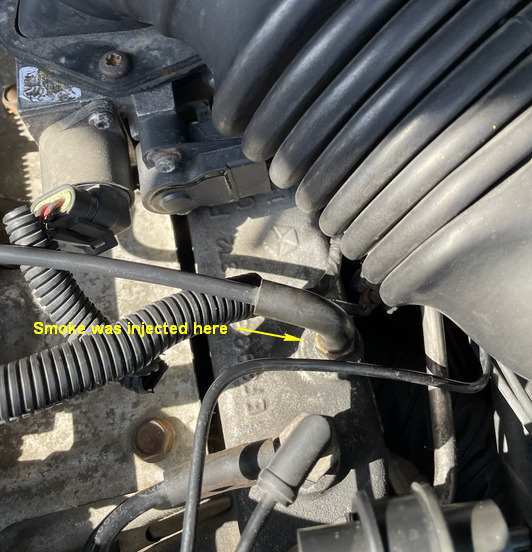
-
MayDay!! - Hard Accel Killed Idle
AnotherOldJeepGuy replied to AnotherOldJeepGuy's topic in MJ Tech: Modification and Repairs
Back on June 11 shop #2 also noted arcing at one spark plug wire to the heater control valve hose that was right up against it. That particular arc was easy enough to fix, just move the hose. He told me to wait until it was dark and spray the plug wires and look for sparks. I did see plenty of sparks. I am still a bit skeptical on this, but I looked around for a single new plug wire. Turns out single plug wires don't appear to be sold at least not new at the typical auto parts places. Before I just in and replace all the wires with "a premium set", I ordered a set off ebay for $6, but goal is to prove to myself if possible that not all wires will spark, or they will, when sprayed with soapy water. I also took off one of the wires that arc-ed a lot for inspection. I see no visible cracks which makes sense, they are new wires. I measured the resistance and got 440-ohms for this one that is 10.75" long. According to the internet, the first time I asked, I should expect 3000-10000. So, fail. But further research seems to be telling me that although the 3k-10k numbers should be seen if I have OEM spec wires, "newer low resistance" wires are also available "now", and that what I have is that, and that is OK. I will post back when I get the new test wires, and repeat the arc test. In the meantime, the questions to the group are: 1. Should I look for original OEM resistance wires or are the "newer" lower resistance wires OK. 2. If I see sparks when I spray soapy water, but not unless I do, are the wires really bad?