


Eagle
-
Posts
15698 -
Joined
-
Last visited
-
Days Won
27
Content Type
Profiles
Forums
Gallery
Everything posted by Eagle
-
Correct. But the reference in the opening post to "stock buttons" doesn't seem to encompass that technology.
-
It's always interesting to see things go full circle. For those of you who don't know, I'm 79 years old. When I was growing up, cars had an ignition switch, and a separate push button for the starter. On some of them the starter button was on the dashboard, on others it was on the floor (sometimes near enough to the headlight dimmer switch -- also floor-mounted -- to cause problems). It wasn't until the mid- to late 1950s that we started to see an ignition switch with an extra, "Start" position built into it. The "Accessory" position came even later. And now we are seeing that taking the "Start" function out of the ignition switch is somehow viewed as an innovation ... when it's actually a reversion.
-
AW4 Not Shifting Out of 1st Gear??
Eagle replied to Quanah_the_89_MJ's topic in MJ Tech: Modification and Repairs
The basic diagnostic in the factory service manual is to remove the TCU fuse and see if it shifts manually. Your transmission passes that test, so the problem isn't the transmission. That leaves the TCU and/or the wiring. -
You were lucky.
-
DO NOT use a Dana 44a. I once made the mistake of buying a WJ with the 4.7L engine. It came with the aluminum rear axle. It spent literally WEEKS in the dealer's shop while first the dealer's techs and then a "specialist" flown in from the factory tried to stop the constant droning/whining noise it made at all road speeds over about 25 MPH. The axle problem was never fixed, and about 6 months after I bought it the engine died at an intersection, never to run again. Chrysler bought it back from me and I replaced it with a 2000 XJ. You want a clue about how bad that axle really is? I bought (as I always do) the factory service manual. The owner's manual doesn't include this information, but the FSM has a warning in it: DO NOT use a floor jack under the differential to jack up the rear of the vehicle. Doing so may cause the differential housing to become deformed. Meanwhile, my '88 XJ with the D35 is at 287,000 miles, has been driven cross country heavily loaded, and has been wheeled hard on some fairly rugged trails with no ill effects. I will take a D35 over a D44a any day.
-
Oracle LED tail lamp harness
Eagle replied to eaglescout526's topic in MJ Tech: Modification and Repairs
I'm personally not interested in aftermarket taillights, but I think having a pre-made harness available would be a great idea. -
3-D printing is rapidly becoming a popular pastime (if it hasn't already become a popular pastime). I'm sure some of you have at least experimented with it. Question: Are there any free software programs for use with 3-D printing? Preferably free programs that are halfwat decent?
-
A couple questions about my Comanche
Eagle replied to CheepComanche's topic in MJ Tech: Modification and Repairs
And what year and engine? That appears to be an AX-15 (or AX-5) transmission. And that photo of the tranny mount looks a bit off. -
I wasn't suggesting that Classy tell his cousin he's an idiot -- that's just among us. For those who apparently aren't aware -- the XJ and the MJ were designed using crumple zone technology. If you have access to u-pull junkyards (they're illegal in Connecticut, and have been for decades), check out some XJs and MJs that have been hit in the front. See how bad the front frame horns and inner fenders are, where the engine ended up -- and whether or not anything made it into the passenger compartment.
-
I have an aftermarket rack. I'd like to retrofit a factory rack. Where can I buy seam sealer?
-
This summer I hope to get my original '88 XJ back on the road. When I bought it, in the Pioneer trim level the roof rack was extra. I didn't think I'd ever have a need for it, so I didn't buy it. Now I wish I had done so. I have a choice of four XJ parts vehicles, all of which have roof racks, that I can take a rack from. What's holding me back is water. Specifically, how to keep water out of the interior after I drill a bunch of holes in the roof. I believe the longitudinal rails screw into nutserts that are drilled into the roof, is that correct? What did the factory use to waterproof all those attachment points? Thanks.
-
Nothing personal, but your cousin is an idiot. I've already told the story of my grad school roommate (the consummate car nut, BTW), who credits their XJ with saving the lives of his wife and two kids when they were hit head-one by a larger vehicle. I didn't mention the '87 XJ I have parked out behind my garage. I bought it from the secretary of a company I once worked for after she was t-boned in the driver's side A-pillar when a car ran a red light. It was towed back to her house, where her then-boyfriend bolted a junkyard driver's door on it, and she continued to drive it. The A-piller is definitely bent and I didn't buy it to fix, I bought it for parts -- but the unibody held up much better than a body-on-frame vehicle of the same size and vintage would have survived. * No airbag * No side airbags * No reinforced beams in any of the doors Did I mentioned that her only injury was a couple of bruises?
-
I don't think anyone has said that.
-
My graduate school roommate's wife had a '92 or '93 XJ. She was hit head-on by a drunk driver, with two young children in the Jeep. She and the kids were uninjured. My roommate is a car nut. He credits the design of that "unsafe" XJ with having saved his wife's life. And you won't get speared by the steering wheel. The steering column has a shear pin in it -- it'll collapse in an accident.
-
Actually, '95, I believe. And only for the driver, correct. The passenger-side airbag didn't arrive until the 1997 make-over.
-
Good news. The 240Z is old enough that things wee basically "standard" -- no fuel injection, crankshaft position sensors, MAP sensors, idle air controllers or any of that to worry about. My roommate in school had one. He crashed it within a few months of buying it (new -- that's how old I am), and had it completely rebuilt with an SCCA competition-oriented suspension. My brother drove it after the rebuild and reported that it understeered terribly. I drove it five minutes later and in my opinion it oversteered terribly.
-
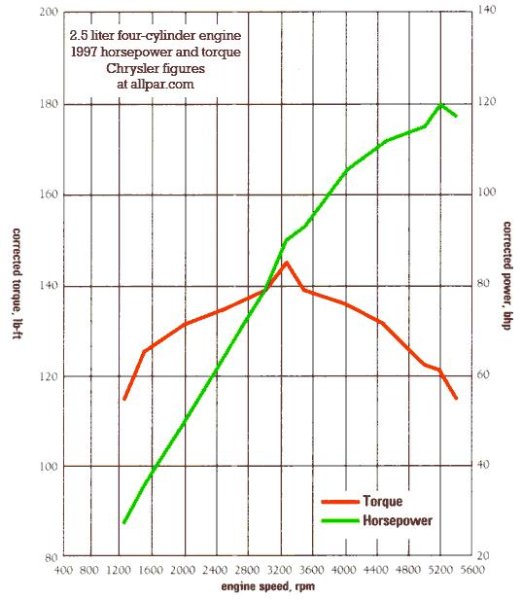
Let's see if I can post the 4.0L torque curve for comparison ...

-
That doesn't hold true for the 2.5L. The 4-speed manuals had 3.54 gears, the 5-speeds had 4.10s. The stock 2.5L doesn't have any low-end torque. Unlike the 4.0L, which in most years reached the torque peak by around 2200 RPM, the 2.5L peaks at 3200 RPM -- and it's very much a "peak," not a flat curve like the 4.0L torque curve. The 2.5 engine is a reliable engine, but in stock form it's pretty anemic. (And that torque chart is from 1997, with the newest Chrysler multi-port injection. The '86 thru '90 2.5 with the throttle body injection was even worse.) With the little tires the 2.5L typically came with, the 4-speed would be turning 3000 RPM at 65 MPH. Gear it up to 4.10s and that becomes 3482 RPM. 75 MPH becomes 4000 RPM. That's churning the engine pretty fast, and for what? You're way beyond the torque peak at that point. Look at the 5-speed, with overdrive but 4.10 gears, and it's not too different. 2600 RPM at 65 MPH in 5th gear, 3000 RPM at 75 MPH. That's on the torque peak. What gears would you swap in? 4.56 isn't much of a change, so you'd probably have to go to 4.88s. Now you'd be looking at 3100 RPM at 65 MPH and about 3600 RPM at 75 MPH. I've owned three 2.5L MJs and two 2.5L XJ. More gear can't create a miracle. That's why I think an RV cam could be a game changer. It won't turn a 4-cylinder into the equal of a 4.0L, but I think it could make a significant improvement.
-
I don't know nearly as much as I should about camshaft design and selection. That Melling cam has longer duration but less lift than any of the Jeep factory cams. What does that translate into as far as the performance characteristics are concerned? I found this: https://www.hemmings.com/stories/article/the-right-camshaft-choice Based on that article, it appears all three of the Jeep factory cams are more performance-oriented than torque and fuel economy oriented. The Melling cam looks like more of an RV type cam, which should be good for fuel economy and street driving applications.
-
I still have the printed books from 2000 and 2002. There were three performance cams for the 2.5L -- Phase I, Phase II, and Phase III Phase I -- P4529656 Duration: 240/240 Overlap: 24 Centerline: 108 Lift: .430/.430 Phase II -- P4529657 Duration: 248/248 Overlap: 32 Centerline: 108 Lift: .440/.440 Phase III -- P4529658 Duration: 256/256 Overlap: 40 Centerline: 108 Lift: .450/.450 The Phase I cam is supposed to be good for 900 - 5400 RPM. The Phase II cam is supposed to be good for 1100 - 5500 RPM The Phase III cam is supposed to be good for 1300 - 5600 RPM For what it's worth, the factory performance cams for the 4.0L have exactly the same specs as the cams for the 2.5L.
-
If the old Mopar Performance catalog is still available, the factory used to offer two cam kits for the 2.5L Jeep engine. I'm sure the cams aren't available, but the old books (from when the Performance Catalog was a printed catalog rather than a web site) had the cam specs.
-
Second photo shows a truck that burned. That article is mostly idle conjecture, with little basis in reality. The Comanche is no worse (or better) than most other compact pickups of similar vintage. My brother owned a '93 Nissan that started to crack in half just behind the cab -- exactly like the MJ in that first photo. Bro caught it, and took it to a welding shop that specializes in repairing vehicle frames. Note: This shop SPECIALIZES in repairing such frames. That means there are enough vehicles on the road (I'm in Southern Connecticut -- we get salt on the roads in winter) with failing frames to sustain a business with a moderately large shop and several employees. They aren't all Jeep Comanches. If you want to see disappearing frames, look under any Wrangler from the salt belt.
-
Years ago there was a guy in NAXJA from one of the Rocky Mountain states who had a cam in his 2.5L. Not that exact cam -- he had one of the factory cam kits. He loved it. He said it greatly improved performance and -- paradoxically -- also improved his gas mileage.
-
First? Radiator and heater core.
-
Fast forward to 18:15