

HellCreek
-
Posts
329 -
Joined
-
Last visited
Content Type
Profiles
Forums
Gallery
Everything posted by HellCreek
-
RDK, I have a set of 3 inch rear springs that we prototyped on our truck. You can have them for the actual UPS Ground shipping. No warranty though on prototypes.
-
Thanks, Hornbrod. I really appreciate it. Tom
-
I have a 1989 2WD Sport Truck. I removed the universal joints from my drive shaft and carried them to the parts store to make sure that I got the correct ones. When I was ready to install the new ones, I forgot which end the slip yoke went on. I have the drive shaft with the rubber insert in one end. I'm not sure if it makes a difference, but I wanted y'all's opinion. Thanks, Tom
-
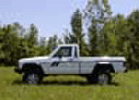
No sweat, Renegade. Everyone is entitled to their opinion. If you look at my Avitar, my Comanche has our 4-1/2" lift installed, and it is sitting 1-1/2" high in the rear. If you want a level truck, you need 4-1/2 inch coils in the front and 3 inch rear springs. We are using Rough Country coils on the front. Thanks, Tom
-
Hi, Renegade, Rusty is correct in stating that the springs will settle. All new leaf springs settle about an inch within the first 1000 miles. This is not the same as sagging, which is what you are referring to on old springs. Besides, pickups are supposed to sit a little higher in the rear so that when the bed is loaded the headlights don't point to the stars. In order to keep a dead-level truck from sagging in the rear when loaded, you would have to have some pretty heavy springs, which would make it ride really rough when empty. We are working on a kit, and we intend to make the rear about 1 to 1-1/2 inches higher in the rear.
-
motor frame mounts 4 cyl vs 4.0L 6 cyl
HellCreek replied to jpfrogger's topic in MJ Tech: Modification and Repairs
Thanks CW. I actually changed both of mine about 2-3 weeks apart, so I did not do a side-to-side comparison. They just appeared to be the same. Thanks for pointing that out. I might have tried to use the wrong ones later and had to return them. Thanks, Tom -
motor frame mounts 4 cyl vs 4.0L 6 cyl
HellCreek replied to jpfrogger's topic in MJ Tech: Modification and Repairs
I just changed the motor mounts on my 1989 Comanche 2.5 and my 1991 XJ 4.0, and they looked the same to me. -
Yet another electrical gremlin..
HellCreek replied to ORCA's topic in MJ Tech: Modification and Repairs
Bad grounds can also make you pull your hair out. Check especially the one behind the driver's tail light. I also had a weird electrical problem with the lights on my '89. Everything worked perfectly until I stepped on the brakes, and then everything went dim, including the dash lights and radio. I checked the ground that I mentioned and the brake light switch. I finally removed the bulbs from all of the turn signals, one at a time, and checked by stepping on the brakes with all of the lights on, and I found the culprit. One of the stop and tail lights was defective - the stop and running filaments were wired together causing a short in the entire system. I replaced the bulb and all is well. Sometimes it is the smallest things that give the biggest problems. -
Bad Vibrations between 35-45 MPH
HellCreek replied to HOrnbrod's topic in MJ Tech: Modification and Repairs
Hi, Hornbrod, Road Force balancing is done by a machine that uses a steel roller to apply pressure to the tire while it is spinning. It simulates actual driving conditions as opposed to a free-spinning wheel, hence the term. I had a severe case of DW before I had my tires Road Force balanced, and it cured them. In answer to a previous question, yes, u-joint can go bad quickly. We had to replace the ones on the rear drive shaft on our CJ-7 after one week. We made the mistake of buying the "Super-Duper" non-greasable ones, and they went dry. Always get the ones with the grease fittings. Thanks, Tom -
X2 that. I just did a power steering conversion on my '89 2.5. You can install a 4.0 power steering pump, that is, until you try to kook up the tube from the air box to the throttle body. The air tube goes directly on top of the reservoir. It seems that the engineers thought a remote reservoir for the 2.5 would be better. The only problem was that, while you can buy a remanufactured pump at most auto supply stores, the reservoir is a dealer only item, and the reservoir bracket (which you must have) is no longer available, so I wound up fabricating one.
-
ever heard of Stanley Springs?
HellCreek replied to JeepcoMJ's topic in MJ Tech: Modification and Repairs
Thanks, Eagle - You got it. -
ever heard of Stanley Springs?
HellCreek replied to JeepcoMJ's topic in MJ Tech: Modification and Repairs
Hi, Pat, What I was trying to say was that, if your original springs are the ones with the 7-5/8" of arch, and you swap them for the ones with the 10-1/4" of arch, you will have a net gain (lift) of 2-5/8". On the other hand, if your original springs had 9-3/4" of arch, then the ones with the 10-1/4 would only give you 1/2" of lift. thanks, Tom -
ever heard of Stanley Springs?
HellCreek replied to JeepcoMJ's topic in MJ Tech: Modification and Repairs
Jeepco, Sorry for the confusion. I assumed that you were taking the 97-555 springs with the 10-1/4" arch from the 1989 MJ and installing them on the 3800, and you wanted to know how much you would gain on that swap. I probably misunderstood you. I will need your address to send you the 6" rear springs for testing. You can e-mail that info to me at tlaher@hellcreeksuspensions.com. Thanks, Tom -
ever heard of Stanley Springs?
HellCreek replied to JeepcoMJ's topic in MJ Tech: Modification and Repairs
Hi, Twisty, Me too. Actually, I was looking at the blueprints. Jeepco, It depends on what you have as a stock spring. Our 1989 Sport Truck had the 3+1 spring with a 8-3/4" standard arch and a capacity of 1100 lbs. Jeep also offered the same spring with 7-5/8", 9-1/4", 9-3/4" and 10-1/4" arch - all made from the same size steel, with capacities of 980 lbs., 1160 lbs., 1220 lbs., and 1280 lbs., respectively. They also offered a 4+1 spring with 9-1/8" arch and a capacity of 1440 lbs., and of course the metric ton spring with 3+2 leaves and a 9-1/2" arch and a capacity of 1700 lbs. Since the springs are pretty much the same, except for the last two, all you would have to do is subtract the arch on your springs from the arch on the new springs to see how much you would gain. The lift springs that we are developing are based on the 1100 lb. springs that were on our Sport Truck, since they were the best all-around spring and would offer the best flex. BTW, would anybody like to test our 6 inch rear SUA springs? Thanks, Tom -
ever heard of Stanley Springs?
HellCreek replied to JeepcoMJ's topic in MJ Tech: Modification and Repairs
Hi, Jeepco, Stanley Springs is an old spring manufacturer. I am not sure that they are still in business. The 97 555 number is a SRI (Spring Research Institute) designation. Like most of the Comanche rear springs, it is made from 3 leaves of .291 thick spring steel with a .622 inch 2nd stage bottom leaf. your spring should have 10-1/4" of free arch (unloaded, or off of the truck). The Metric ton spring should be a 97-571, which would have a .291" main leaf, .323" 2nd and 3rd leaves, and a 2nd stage pack made from .590 and .625. The capacity on your springs would be 1280 lbs, and the capacity on the 97-571's would be 1700 lbs. Thanks, Tom -
Hi, DirtyComanche, If you weld spring steel, you will make it brittle.
-
Hi, Jeeperjohn, If you will tell me the thickness of the leaf pack from the bottom of the clip leaf (the one with the rivet holes) to the top of the main leaf, I will send you a couple of factory clips with the rivets. I will need your address, too. My e-mail address is tlaher@hellcreeksuspensions.com.
-
front driveshaft lengthen
HellCreek replied to 88swampedmj's topic in MJ Tech: Modification and Repairs
As long as you use good straight D.O.M. or CDS tubing, you should not have a problem. We did that on our CJ-7 and have been running it for about 5 years. Just make sure that you get the yokes welded on straight and in phase with each other. -
Death wobble and alignment issue
HellCreek replied to JOMJ87's topic in MJ Tech: Modification and Repairs
Sorry, this was addressed to the wrong person. It should have been directed to JOMJ87, but you get the idea. Thanks, Tom -
Death wobble and alignment issue
HellCreek replied to JOMJ87's topic in MJ Tech: Modification and Repairs
Hi, CWLONGSHOT, I've got to agree with the others in all respects, but I would check the balance first. On my 89 Sport Truck, I had just installed our 3 inch kit and test drove it. At about 45 mph the steering wheel was almost ripped out of my hands (I've got manual steering, so it was probably amplified). I took it to the tire shop and they balanced all four wheels with no improvement. I checked everything for tightness and was satisfied there, so I took it to another tire shop. They had what they called a "Road Force" balancing machine. This machine checks the balance of the tire while pressure is being applied by a steel roller. After checking the tires on that, I wound up buying new tires, since the old ones had such heavy spots that they could not be balanced properly. That fixed the problem, and I can drive safely now at any speed, within reason - of course. -
Rear Proportioning Valve Comments
HellCreek replied to HOrnbrod's topic in MJ Tech: Modification and Repairs
Hi, JeepcoMJ, Not to worry - been there, done that. I will let you know when these are ready. Hi, Don, Actually my first contact with a rear brake proportioning valve was on a Chevy 1 Ton that I owned. It seemed like a great idea to me - the more weight you put in the bed, the better the brakes. It still seems like a good idea - if it works properly. Yeah, I hate AALs as well. It's not so much the AAL itself, which is the cheapest way to lift a vehicle when you can't use blocks, it's just that, if the rest of the spring is weak, the lift is doomed to failure. The same can be said of SOA, unless you buy new springs or already have a set of good ones. I will keep y'all informed (Mississippi for you guys), and I appreciate any help that anyone can give me. Thanks, Tom -
Check with Rusty's Off-Road (http://www.rustysoffroad.com). They have long arm kits for XJs, which would be the same on the MJs on the front end.
-
Rear Proportioning Valve Comments
HellCreek replied to HOrnbrod's topic in MJ Tech: Modification and Repairs
Hi, This is not an OME kit or anything like it. Our kit is made up of Heckethorn (Rough Country) parts for the front and our own manufactured leaf springs for the rear (they go under the axle as Jeep intended). We also use Rough Country shocks. You will not find this kit on our website, since it is brand new and not quite ready for production. The prototype kit is on our MJ. Thanks, Tom -
Rear Proportioning Valve Comments
HellCreek replied to HOrnbrod's topic in MJ Tech: Modification and Repairs
Hi, Yes, we are supplying longer shocks for the front and rear. Essentially, the front is the same as a XJ Cherokee lift. As you know, the rear requires longer springs designed to go under the axle. We have developed those using our MJ as a pattern. Our Avitar is our Comanche with the 4-1/2 inch kit installed. Thanks, Tom -
Rear Proportioning Valve Comments
HellCreek replied to HOrnbrod's topic in MJ Tech: Modification and Repairs
Hi, What we did was make the shaft 3 inches longer than stock for the 3 inch lift and 4-1/2 inches longer for the 4-1/2 inch lift, but, as I mentioned, we have a 2WD Comanche. You indicated that the 4WDs had different length rods, and we were wondering what those differences are. Thanks, Tom