

txjeeptx
-
Posts
80 -
Joined
-
Last visited
Content Type
Profiles
Forums
Gallery
Everything posted by txjeeptx
-
Does it still make the noise when you turn the OD off with the push-button switch in the lower right side of the dash panel? I've seen a noisy overdrive unit before.
-
I had a similar vibe problem with my 2wd MJ. Turns out the rear driveshaft on mine had a rubber sleeve in between two pieces of tubing that made up factory the driveshaft. I tried replacing the u-joints twice to get rid of the vibe, then gave up and took the shaft to have it balanced. The drivshaft shop said it needed to be replaced with a new shaft. I do a lot of business with this shop for my other Heeps, so I trusted what they were tellin me, and they were right. After the new shaft, which doesn't have any rubber damper BS parts to it, the vibe was gone. Does yours look like it has an inner and outer tube with rubber sandwiched in between, pretty much the whole length of the shaft? If so, then that's likely the cause of the vibration - the rubber is dried out/worn out.
-
Spitting and Sputtering
txjeeptx replied to buck_hunter's topic in MJ Tech: Modification and Repairs
You can test for intake manifold-to-head leaks with any carb cleaner that makes the engine stumble when sprayed directly into the throttle body. It'll make the engine stumble when/if you find a leaky intake gasket. I got my injectors from a local SATX company Fuel Injection Specialties, http://www.fuelinjection.com/. I ordered a set of ACCEL Ford-style injectors through them, but went with stock 19 lb/hr, since I don't have a cam or bigger TB, or free flowing exhaust. My engine is stock. The Ford style injectors have a different spray pattern than the stock Seimens - 4 tiny holes in the spray nozzle instead of one. The set of injectors was about $250 if I recall, so not cheap. -
Spitting and Sputtering
txjeeptx replied to buck_hunter's topic in MJ Tech: Modification and Repairs
Hmmm, you know that the octane rating is about preventing detonation, so the higher the octane rating, the slower the fuel burns (a flame front/moderate pressure wave), rather than detonating(an explosion/high pressure wave). High octane is only needed to prevent detonation in higher compression, higher performance engines(think Porsche or Vette). The Jeep engines are tractor engines with low compression, so higher octane fuel does nothing to help them run better. Sometimes higher octane can help prevent pinging in hot operating conditions, but that's about all it'll do for a Jeep. It might even be a detrimental thing in extreme cold conditions, since higher octane fuel is less volatile. Higher octane fuel does have a slightly higher heating value than lower octane fuel, so it does have more energy in it, and can result in better fuel economy. But, it usually just winds up costing you more money for what amounts to a performance placebo - you think it runs better, so to you it does, but its all in yer head. If the extra cost at the pump makes you feel like your engine will run better, then I guess its money well spent, but a Jeep engine doesn't need high octane and usually doesn't benefit any from it. My fuel-nerd rant aside, there are some other places to look for problems, but my bet is still on a vacuum leak. One other place I'd look is to check that the TPS doesn't have a dead spot in it, where it goes from sending a signal related to the throttle position to having an open circuit in one spot. That would confuse the heck outta the EFI computer. I also have had problems with MAP sensors with low signal output, where the sensor works, its just not in the range the computer expects to see. Could also have gummed up injectors, if you're MPI. My MJ really liked its fresh set of injectors, made it idle smoother, accelerate better. Finally, the EGR might be coming open too quickly. One other thing - if the spark plugs are gapped too much or old and worn(rounded), the coil might have no problem at idle but struggle when trying to accelerate the engine. Ha, I didn't even bother to ask what engine you have. '87 means at least it won't be the carb'd 2.8. -
The 228 is the same case as the 229, only the 228 has a open center differential like the 242, while the 229 has the viscous coupler. I thought the 228 was only a FSJ case, but if there was an option for Selectrac in XJs in 86, and the 242 wasn't available/didn't exist yet, then that would be the case that was used. 228/229 are driver side drop cases in Jeeps, so one would work in an XJ as long as there's room in the floorpan. Would be interested to see what kind of shifter Jeep used if they put this case in the XJ/MJ, because the FSJ 228/229 stuff was vacuum actuated for shifting between 2wd and 4wd, with a lever for high lock/N/low range, similar to what the AMC Eagle used(without the low range lever, and the t-cases were called the 118/119 full time AWD, and 128/129, which was Eagle's "Select-Drive", which had 2wd option).
-
231 AMC was made before the Chrysler takeover of AMC. Its the same as the 231J(and interchangeable, whole or interals), except that all AMC cases had 21 spline inputs, while the 231J has either 21 or 23 spline inputs depending upon which engine it was behind. The 4cyl 231J had 21 spline input. Seem to recall that some 6-cyl 231Js were also 21 spline input, but they were behind the Peugeot BA10/5. All 231Js behind the AX-15 and Aisin AW4 autowere 23 spline. (Correction: After 1990, thanks carnuck, didn't know pre-90 AW4s were 21 spline - so I can guess that nearly all AMC t-cases were 21 spline, then, because the AX-15 didn't show up until mid '89). Info from herehttp://www.novak-adapt.com/knowledge/np231.htm.
-
Spitting and Sputtering
txjeeptx replied to buck_hunter's topic in MJ Tech: Modification and Repairs
Check the intake/exhaust manifold bolts to make sure they're tight. Sounds like a vacuum leak might be causin yer problem. Also look for broken plastic vacuum lines. -
Significant lack of power...
txjeeptx replied to Thunderbear's topic in MJ Tech: Modification and Repairs
Could be the fuel sat too long. This Ethanol junk they add to the fuel now separates out and sucks up water, fouling the fuel quickly, like in as little as a month. Other than that, maybe fuel filter is in need of replaced, maybe there is a sensor going out or out of its operating parameters in the cold weather. There's also a chance the engine sat long enough to have the piston rings get stuck/don't seal properly, losing compression, but you'd have bad blowby showing up as pressure in the crankcase/valvecover. Does it smoke much out of the PCV hole when you take it out while running the engine? Also, with all inline engines, when was the last time you checked to see if the intake/exhaust manifolds are still bolted up tight. The bolts back off and cause a vacuum leak. -
207 isnt an AWD case. Its part time 4wd with a low range, for off-pavement use only when in 4wd. No differential, which the 242 has. The 229 is a full size Jeep t-case, AWD with a 2wd mode and a low range. It uses a viscous coupling rather than an open diff, which the 242 has. The ZJ 249 uses a viscous coupling, but has no 2wd mode - it is full time AWD. 242 has 2wd mode, AWD high range for pavement, 4wd high locked mode for off road, and a low range. If you want to swap in a 242, you need the shifter from the donor XJ that is gated for the 242's shift pattern. There is some arguing about it, but generally, any t-case with a viscous coupler(229,249) tends to outperform one with a open center differential(228,242) in snow.
-
WJ Booster and Master Cylinder Upgrade
txjeeptx replied to Comanche County's topic in MJ Tech: DIY Projects and Write-Ups
Haven't been active round here in a while, but while I've got another pot on the burner elsewhere here, I thought I'd add some more info. I had a minor issue with the brakelight not working at times. I think I have it worked out now, but it came down to having to grind a bit more on the pushrod. As you depress the brake pedal, the switch rotates a bit, and it can reach a point where the switch goes open again. I ground a bit more off the upper part of the area that needs grinding for the switch flat. Seems to be working fine now. Truck stops like never before, this swap is a modification that ALL older XJ and MJ owners should do first before doing anything else to their truck. And, yes, never use compression fittings on high pressure hydraulics! EDIT: Still having brakelight issues, but its not with the switch, this time. Its somewhere in the harness, most likely the hacked-up mess of wires behind the fusebox. In the process of fixing that now. EDIT par II: Fixed the wiring harness, but still had a finicky brake light switch. Pulled the booster and welded some material back onto the top and bottom of the flat I ground in it during the inital conversion setup, then ground it all to the same flat. The switch is much happier with a larger flat area than what you can get by just grinding, since the flat for the switch now has a shape more akin to the factory pushrod. Brakelights finally work when they're supposed to. -
Seriously. What do you think it is? Pic is of Cartoon Network show "The Regular Show". Credit where due.
-
There's a trailer running on CN for a cartoon called "The Reguar Show", a totally awesome moronic three-beer-minimum-requirement show about nothing, that has the two main characters pitted against each other in a staring contest that takes place in front of a decent depiction of our favorite vehicle. Can't find it yet on CN or hulu, may have to snap a pic of it on my phone fer y'all to see what I'm talkin about. . . er you could just grab half a six pack, kick it on the couch and watch CN till it runs again. :cheers:
-
Native to the hills of Central TX
txjeeptx replied to txjeeptx's topic in Member Projects: Your Comanches
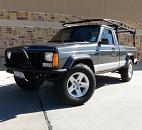
Some more info on the truck - I searched for nearly a year to find one with a 4.0 and the AX-15. When I came across this one up in Dallas, it was sitting in the back lot of a Just Jeep place. It didn't run, and needed a clutch and the AC was discharged. I paid waaaay too much for it in the condition it was in, and for how the salesman flat-out lied to me about the mileage and condition of the truck just to get me to drive up there. I trailered it home. With a fresh battery, it barely ran enough to drive it off the trailer. It was a zombie Jeep. The mechanical restoration was and always will be an ongoing thing. The clutch was done at the Jeep dealership, since I was busy with school. The AC was charged with R-12 by Carlisle auto air here in town. I drove it for about a month, then got the TJ Rubicon wheels and some fresh Michelins and threw on a spacer lift and rear shackles. Since I live near a college campus, I drive daily through Mecca for the world's worst drivers, so I had a girl pull out in front of me on a rainy day and couldn't stop. Although she was determined to be at fault, the insurance company was only willing to give me a grand for the damage. I dumped three more into a paint job that took the shop that did it two months to finish, and it was a crappy job. I shoulda sued them for my money back. The paint is peeling on the roof and fender flares, now. They're willing to repaint the roof and flares for free, but I had another accident in the meantime which damaged the entire front clip. Its cobbled back together decent enough for daily driver duty with a beefier front bumper from Quadratec(OR-Fab). I painted the brighter silver highlights on the rockers myself, as well as the Jeep lettering on the tailgate. I bought the rack from Northern Tool, and modified it to fit the MJ by cutting 17" of length out of it, and lowering the rack height by 4.5". The mounts are modified to be much smaller than what came in the box, and I countersunk the bolt heads on the bed rails so the factory Comanche lettered bedliner would fit back over the rack mounts. The rack was for a kayak that I never bought, but it has served as an awesome lumber hauler and general cool modification, personalizing the truck to me. I have a rack on my 2007 F150 because of how much I liked the rack on the MJ. The MJ's rack does not make any wind noise, but the one on the ford needs a fairing on the front tube to get rid of a howling noise it makes on the highway. I recently finally got the brakes to work the way I always wish they had all along. The WJ dual diaphragm booster swap is the best upgrade you can do for your MJ/older XJ. I did all the recent cleanup work on the truck to try to sell it, but, now that it drives the way I want it to, I'm keeping it, in spite of my wife thinking I have too many project cars. I almost forgot - yes, its an Eliminator, no that bench seat was not factory - I swapped it in so my wife and son could ride around with me. Its out of a junkyard '86 MJ. My son is now too big to ride in the middle, so I had to get a bigger truck, and I liked the Ford SuperCrew design, so I bought an FX4. Too bad Chrysler doesn't build a crew cab Jeep pickup. -
Empty Post
-
WJ Grand Cherokee brake booster/mc swap
txjeeptx replied to txjeeptx's topic in MJ Tech: Modification and Repairs
I'll have to take some better pictures after my camera charges up. Found the proper place I shoulda posted this, found a more detailed/picture-strong writeup here in the DIY projects. Every forum is different, I hadn't been all over this one, and did some weak searches on the subject I posted here. Delete? Move? -
WJ Booster and Master Cylinder Upgrade
txjeeptx replied to Comanche County's topic in MJ Tech: DIY Projects and Write-Ups
Great writeup. How'd I not see it before? "Search" is only as smart as the user. I had to modify the firewall more than you did to get my WJ booster to fit. I ground the large center hole larger to fit the WJ's larger booster pushrod section, and I ground down the two vertical ribs to either side of the booster mounting location. I also pushed the clutch hydraulic line over the booster instead of behind it, and did some minor rebending of the line to clear the booster on the engine side. I used a bottle jack and some scrap lumber to make the push upward on the horizontal firewall pinch seam to clear the booster. This allowed the booster to sit all the way on the firewall without being pushed up against any other part of the firewall or any hydraulic lines or the vacuum lines. I rebent the WJ hard lines and cut them shorter, cut off the factory MJ distrubution block line fittings, and flared them onto the WJ lines. The install looks factory. There is no problem with fitment for the factory MJ washer bottle. I bled the system per the suggestion to "confuse" it into thinking there are no front brakes - ie, you bleed the rear brakes with one of the front brake bleed valves open (and attached to a hose and fluid container so no air gets back in the front brakes - basically, its like you are bleeding the front and the rear at the same time). This bleeds the line between the rear load sensing proportioning valve and the distribution block near the master cylinder. The WJ dual diaphragm booster and master cylinder is one of the best modifications I've ever done to my MJ. It stops like a completely different truck. -
WJ Grand Cherokee brake booster/mc swap
txjeeptx posted a topic in MJ Tech: Modification and Repairs
First post, shoulda joined long ago. I've had my MJ since 'o5, it’s a charcoal silver shortbed Eliminator 2wd with TJ Rubicon wheels. My truck was a zombie when I dragged it home. I gave it a new life, but it still liked to eat cars(brains to a zombie Jeep), since I've had two accidents where the other driver pulled out in front of me without adequate space for me to slow down. "Oh, I thought you could stop." Impatient college kids(both chicks), they need to take a physics class. I've pieced my MJ back together and used it as a daily driver, and replaced the booster/mc with stock parts(back in '06), but the brakes still sucked. I lived with it for way too long. I recently bought a newer bigger safer truck(wife’s request), and decided to try to sell the MJ. I started to wrap up the unfinished projects on it, but had no luck with the sale (y’all might have seen it on c-list and the big auction site). After this swap, I think it’s a keeper, again. It all started when I decided to replace the rear flex hose, since it looked bad. Then I couldn’t get the brakes to bleed correctly, and came across the info for how to bleed the system for the rear load sensing proportioning valve here on this site. Thanks! But, the system still wouldn’t stay bled. Time for a new master cylinder. I started looking into what other booster/mc combos would work as an upgrade. I came across the mid '90's XJ dual diaphragm swap, and one involving the '99-'04 WJ setup. I looked for both setups, and came across far more '99-04 donor possibilities in the parts yards. I picked up a good, useable WJ booster/mc for $80. The swaps I read about involved the use of a ¼” spacer between the firewall and booster. This lowers the pedal by an inch, since most power brake systems use a roughly 4:1 pedal ratio. I didn’t like the way this setup looked or felt, so , after spending a good part of the day fabricating a spacer, I decided to chuck it and figure out a way to mount the booster directly to the firewall. I had to grind out the large center hole to make room for the larger diameter pushrod housing on the WJ booster. There are also two vertical ribs on the firewall on each side of the booster mounting holes that I had to cut off about 3/8”, so the booster could be bolted to the firewall. I also clearanced the horizontal pinch seam above the booster by folding the downward-pointing lip inward, then I used a bottle jack and some scrap lumber to push the seam upward. Here are the left and right seams that had to be ground down: After modifying the WJ pushrod by drilling the bolt hole out to 5/8” and grinding a flat for the stoplight switch, and modifying the WJ master-to-distribution valve hard lines with the old MJ line fittings flared in place, I bled the system, chased the stoplight Gremlins with a new switch, and finally got to go for one of the most satisfying test drives I’ve ever taken. Of all the swaps and customizations I’ve done to my MJ over the years, this is by far the best one! Anyone with a die grinder or Dremel can do the firewall modifications and not have to use a spacer. Modifying the WJ MC hard lines took a lot of practice to get familiar with the flaring tool. If you have the basic mechanical knowledge necessary to replace a brake booster/master cylinder, I can’t say enough about how much of an improvement this swap will make to how your MJ/pre-’95 XJ will stop. I did not take the time to snap any pics during the swap, but I will take some of the finished product soon. It looks like it came from the factory with a dual diaphragm booster.