

brucecooner
-
Posts
240 -
Joined
-
Last visited
Content Type
Profiles
Forums
Gallery
Everything posted by brucecooner
-
brake reservoir sediment (red mud, rust, ???)
brucecooner replied to brucecooner's topic in MJ Tech: Modification and Repairs
That tracks with my experience. When I bought it it didn't particularly care to stop. Even less so now that I've "worked" on the brakes. *ahem* I had noticed there didn't seem to be any action from the cylinders when I was bleeding and son pressed the pedal. My duh, non-mechanic self didn't put it together at that time though, replace the cylinders. So yes, new cylinders for sure. The shoes aren't thick but seem okay so I'll roll with the existing ones for now. The rest of the brake guts are not too awful rusty, but I'll have to see if I can get the adjusters to move and tune them out when everything is back together. -
brake reservoir sediment (red mud, rust, ???)
brucecooner replied to brucecooner's topic in MJ Tech: Modification and Repairs
Thanks! It bugged me that I didn't know what was taking place under the bed (truck bed), so I crawled under the rear axle this evening and mapped out what goes where. Here's the result for the morbidly curious, it might even be correct. I had to guess on which was the regular supply and which was the emergency bypass, but I figure the one going to the prop. valve has to be the regular. And of course, these tubes are hideously complex on the truck, it's like a plate of spaghetti under there. This appears simpler than I thought it would be though, as I think I just need to plumb the regular supply to the flex hose that then goes to the axle. With the proportioning valve functionality moved up under the hood of course. I'm not sure how much of the old tube I want to rip and replace. It looks like I'd have to drop the gas tank skid plate, and most of the tubing is wrapped in gravel guard too, which I should probably keep, especially across the axle.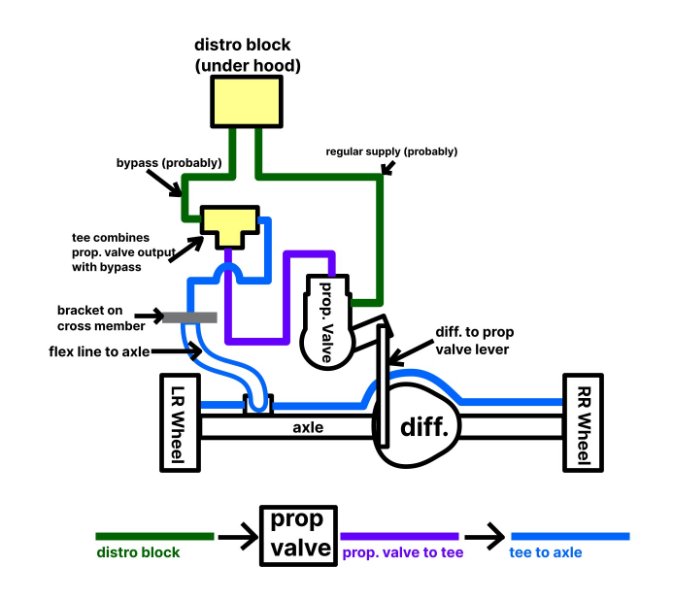
-
brake reservoir sediment (red mud, rust, ???)
brucecooner replied to brucecooner's topic in MJ Tech: Modification and Repairs
That is absolutely what I'm after. My diagram didn't make it clear, but that is an adjustable prop. valve on the rear line, the distro block is gone. Any recommendations for brand/model? Ideally, I'd like to install the same valve you do so I can just use your setting. :) Also, does the old brake dash light connector need special treatment once the block is removed? Also, are braided steel hoses for the flex lines an upgrade worth considering? -
brake reservoir sediment (red mud, rust, ???)
brucecooner replied to brucecooner's topic in MJ Tech: Modification and Repairs
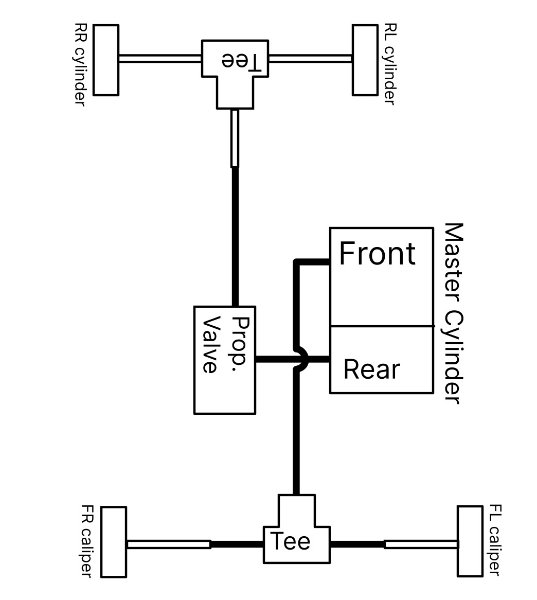
Sorry if you guys thought you were finally rid of my antics. Everything was moving along until whatever health issue has been nagging me for the last two years decided to knock me out, so I was mostly bedridden through the end of the year. I'm still not operating at 100%, but I do what I can. On the brake front, I finally got to bleed everything, two and a half times because Comanches are special *grumble*. I got it out on the street and found out I have slightly less brakes than before. I don't think the rears are pulling their weight. To top it off after a couple of blocks the brake pedal went toward the floor and I heard a hissing noise again. The booster sort of "sucks" the brake pedal to the unengaged position, but when you get past a point, the brake pedal falls down and you hear a vacuum leak. It doesn't leak as bad as the one it replaced, so I guess that's a hollow victory. So job 1 is procuring a new booster. I'm just going to return this one by tossing it through the front window of the store where I got it and get another brand. Cruiser sounds like a broken record but he's right, they really don't make 'em like they used to. As well, the rear brakes are a little crusty. If I'm trying to restore braking function, I really should do something about them. The hardware's not in horrible shape, but maybe new cylinders and shoes at the minimum. Also given the gunk I found in the rear chamber of the old master cylinder, new cylinders are probably a good idea anyway. The front calipers are fairly clean and I know they're grabbing good (the smell when I got out last time I drove it told me as much) so not as worried about them. Fixing the rears would probably fix my stopping problem, but I've decided I just don't trust the distro block or the rear prop. valve. During the bleed, I never saw the dash light come on to indicate the bypass valve had shuttled (and I did clean up the brake light connector while I was installing the new master cylinder. Goodness knows if the valve is stuck in place or what's going on in there. I have NO clue how well that rear prop. valve is or is not doing it's job. I'd also like to be intimate with every inch of brake line under there, and not have to bleed it TWO AND A HALF TIMES whenever I work on the brakes. I've started figuring out how I THINK the layout goes, based on my interpretation of various threads here and elsewhere, and have made up a totally naive starting point, which will get refined. I still have lots of questions around the rear end, so my plan is to drop the spare and reverse engineer the current line layout for clues about fittings and such. In this diagram I assume it's hose line from the rear tee to the wheels which is probably not the case. On a scale from boneheaded to dumb*ss I give this a 60% chance of success. I got some brake line and a flare tool to practice with though. So currently trying to run down Dana 44 rear brake drum stuff. Way it goes here lately, I'll probably get sick again and be taken down for a while. Then in a month or two when I encounter another giant setback on what started as a simple brake booster replacement, I'll post again.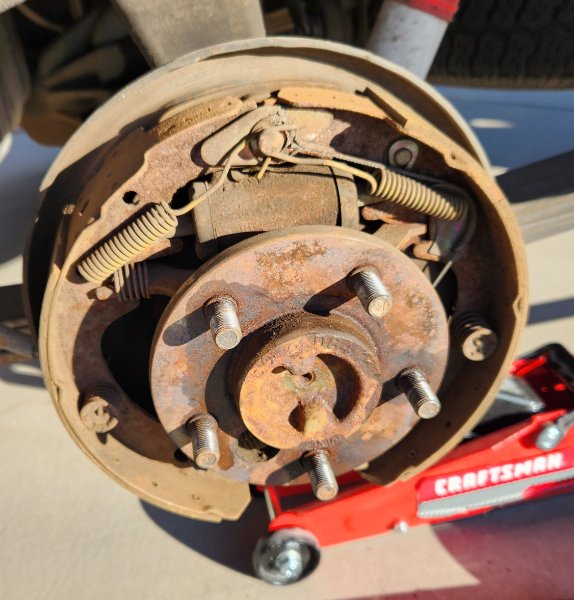
-
brake reservoir sediment (red mud, rust, ???)
brucecooner replied to brucecooner's topic in MJ Tech: Modification and Repairs
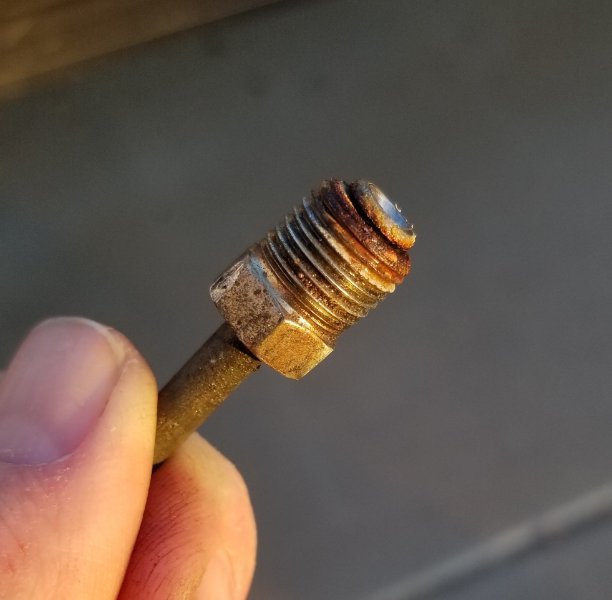
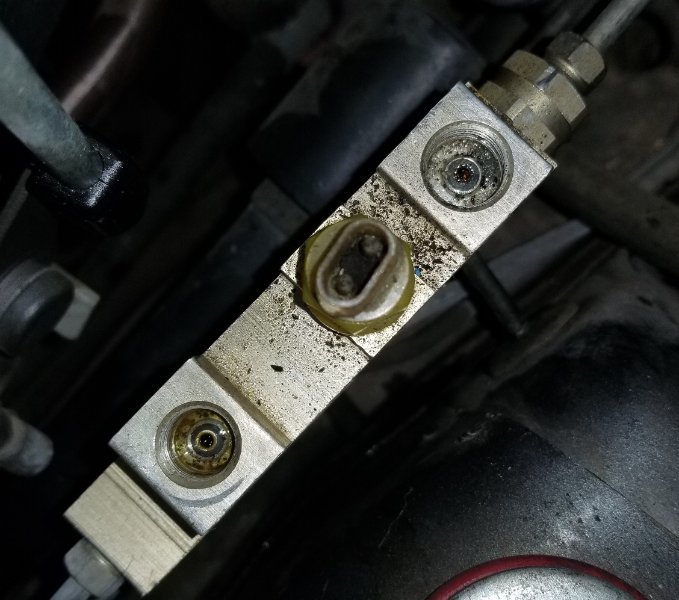
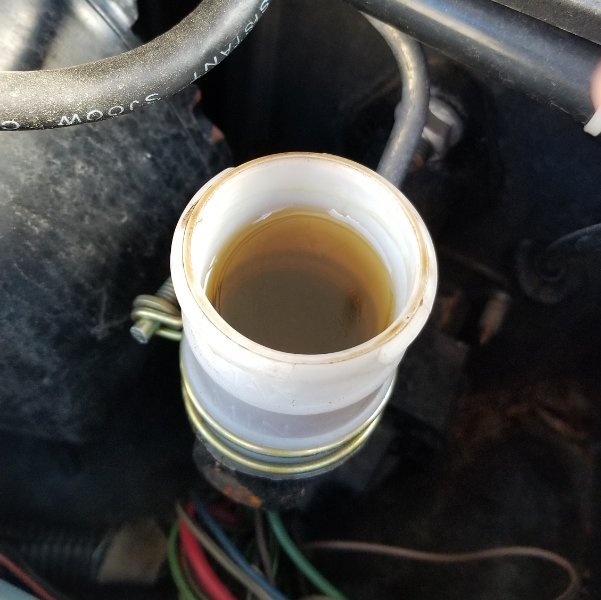
Out of morbid curiosity I stuck a pick into the lines. I got this green gunk out of the rear brake supply (front of the cylinder). Could be old crusty brake fluid I guess. The front line (rear of cylinder) actually didn't seem to have any gunk in it, weird given the amount of red mud in that cylinder chamber. The top fittings were....okay, and the lines weren't corroded or rusted, but I had half rounded one of the fittings, so with some more applications of penetrant and the heat gun, and holding the block very tightly in my giant channel locks, I did manage to get these two lines free from the block. The lower fittings are.....ew. Whatever the gunk is doesn't seem to have attacked the lines or the brass (?) fittings. They seemed to clean up okay. The block has some crud around the fitting ports, which I intend to get out, somehow. No idea what it might look like inside. I have zero desire to pull that block out though. I'm pretty sure you have to disassemble the entire front half of the truck to get to those lower fittings and given how tight the ones I've freed are it's gonna be a pain. If it'll live on with a good flush, I am perfectly fine with that. I kind of want to replace these two main supply lines though. At least the one that now has a nicely rounded fitting. I'm not above getting a kit and practicing flaring. Partly out of curiosity, to see if I can. I've debated deleting the load sensor, and this might be the time to do it, but I'm not sure how big a job that is, and I want to get this guy back on the road (I miss driving it). Having the load sensor doesn't bother me but I'm wondering, are they prone to going out at 30+ years of age?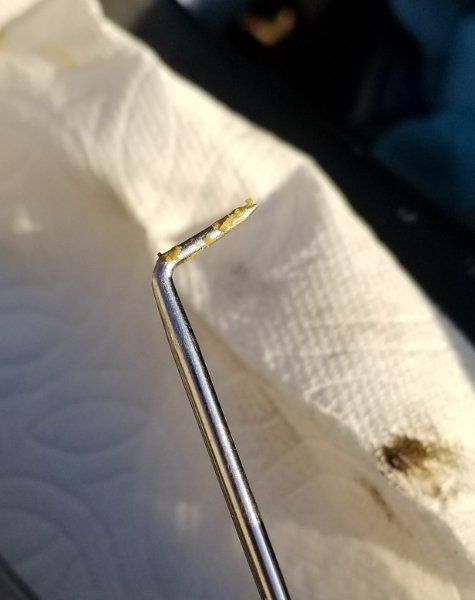
-
brake reservoir sediment (red mud, rust, ???)
brucecooner replied to brucecooner's topic in MJ Tech: Modification and Repairs
You lucky devil. I call Wickenburg to White Spar Road the "back way" to Prescott. Beautiful scenery without all the lights and traffic on SR69. I bet you get to go over the Black Hills on 89A to the Verde Valley whenever you want too. That descent from Mingus to Jerome always stretches my eyes open, one of my favorite few miles of road. I've gone a few times the "back back way" to Prescott, up to SR 96 and over to Iron Springs Road. Stunningly beautiful drive, but a relatively empty corner of Arizona with awesome views and empty roads. -
brake reservoir sediment (red mud, rust, ???)
brucecooner replied to brucecooner's topic in MJ Tech: Modification and Repairs
That's a good idea, switch colors as an indicator when flushing. That Miata must have been tons of fun on twisty mountain roads. Did you have it in AZ, and if so did it ever see White Spar Road? I did make some progress today. With some proper line wrenches, the 1/2 inch fitting broke pretty easily, but the 7/16th did NOT want to turn. I spritzed some more penetrant on the the fitting and heat cycled it with a heat gun a few times. I rapped it with a ball peen hammer a few times for good measure too and it finally turned, but not without some rounding off. I went ahead and picked up a new master cylinder this weekend, but... The fittings and lines that came out are pretty grody (pictures below), and since I half-rounded the smaller one I'm thinking I should look into a new solution there. Is it easy to get replacement lines to go between the cylinder and prop valve? Can you just get like, six inch braided jobs (with correct size fittings of course) or is bending my own and attaching fresh fittings the only way forward? Of course with the master cylinder out it wasn't too awful hard getting the new booster in, despite the contortions involved reaching those upper bolts. A small victory, but at least I kept the "parts to install" pile at the same size.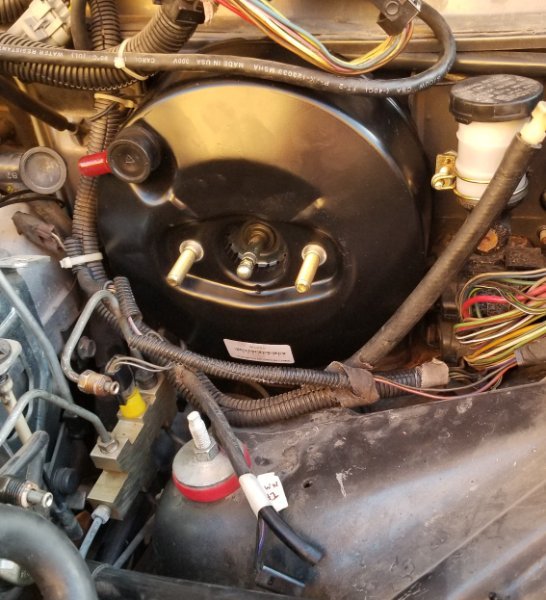
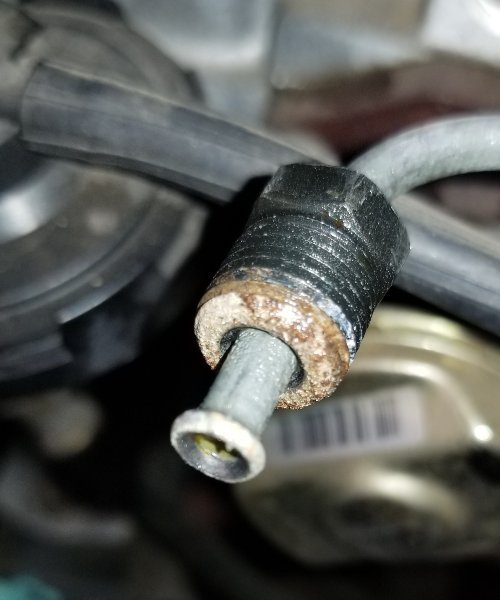
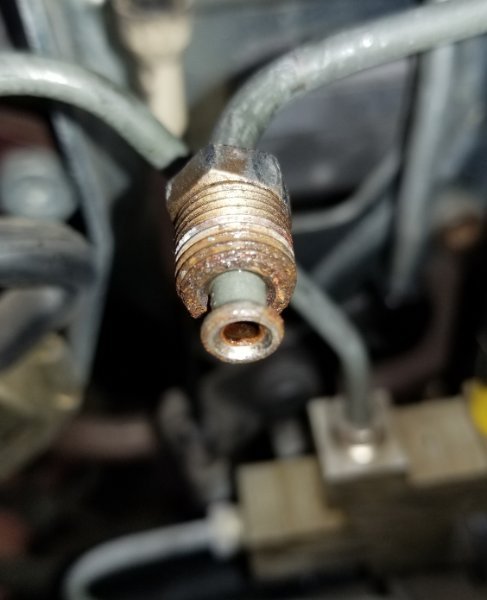
-
brake reservoir sediment (red mud, rust, ???)
brucecooner replied to brucecooner's topic in MJ Tech: Modification and Repairs
Yeah, my fear is that whatever this is has gotten to the seals in everything all the way out to the wheels. My greater fear is that it will have affected the lines themselves, which will make for a very yucky experience. I was already wanting to replace the cylinder/reservoir, but was going to put if off and do the booster alone. I had foolishly hoped the booster could be done without having to loosen a fitting, alas it was not to be. I do like your idea. New cylinder, start from there. And look for that specific wrench, and hope I don't have to flambe any fittings. :) -
The Heartbreaker gave me a great big holiday surprise today. Two questions. What is red mud in the brake fluid reservoir a sign of? What is green fluid in the brake fluid reservoir a sign of? (pictures below) The story so far... I finally started on the brake booster replacement today. Everything was going well until I figured out the booster probably wasn't coming out with the reservoir/cylinder in place. I guessed they tend to get replaced as a unit. So I figured I'd undo a couple of fittings, deal with the mess, and bleed the system, which I was wanting to do anyway. Before loosening any fittings I figured I'd drain the brake fluid reservoir so I didn't have a large spill on my hands. I got a little plastic cup and started bailing the large side of the reservoir. The fluid was clean looking at first, if a bit red, but as I started getting to the bottom of the reservoir I started pulling up red mud from the bottom. Uh oh. The other, smaller side of the reservoir yielded green fluid. It's like Christmas inside there. Or, as my son described it, cajun and wasabi. Or maybe red and green salsa. Whatever it is, I'm guessing it shouldn't be in the brake fluid reservoir. Yuck. The red is probably rust? Maybe the system took in a lot of water at some point? So at the least a new reservoir/cylinder is in order, but I'm wondering about the further ramifications of what I found. Would I expect this crap to be in all the lines? All the way out to, and into the calipers? Would this call replacing all the lines and calipers? Or would a solid flush be sufficient? If it's a sign of water, I'm guessing you don't want to keep any of the old hardware in the system. And related question. The brake line fittings on the reservoir do NOT want to break loose. I rounded a corner of one fitting. (odd note: one of the fittings is 7/16ths and the other is 1/2 inch) However neither would the fittings down on the prop valve break loose either. My fear is that the rust has invaded all the fittings. I spritzed them with some penetrant and left them to think it over. Any advice on getting the lines loose without breaking things?
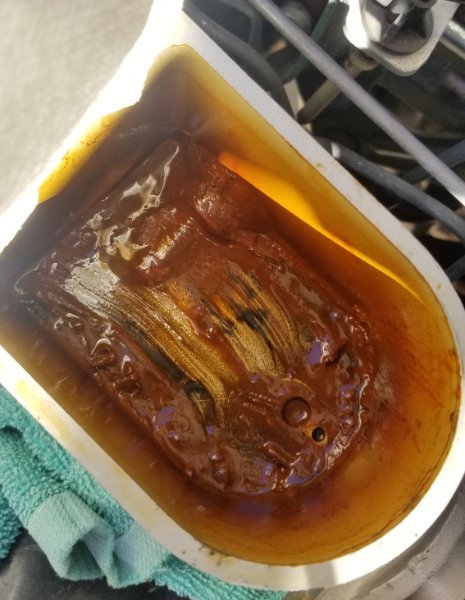
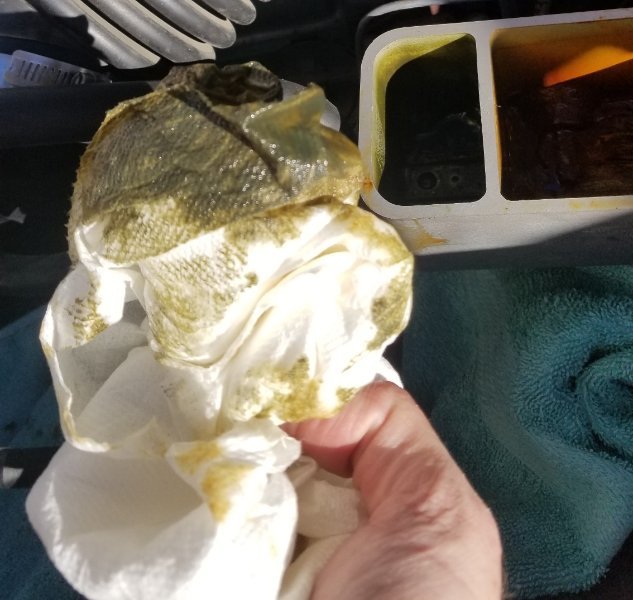
-
I drove it a bit today, and it behaved exactly as you described. When I started, all the gears except 2nd were friendly. After it got warm, 2nd joined the group and played nicely. There is a small amount of fluid where the original clutch leak showed up, but that could be oil getting blown back from the small drain plug seep, so just keeping an eye on it for now. Long as it's just 2nd acting up though, going to turn up the radio and not worry about it.
-
For science! Got behind the wheel and pumped the clutch about 50 times. Took it out for a spin around the neighborhood. It was only 2nd giving me trouble this time. 3rd has been problematic lately, but not after all that pumping. Our neighborhood streets are covered with speed dips (think shallow little drainage ditches) so there was a LOT of slow rolling shifts into 2nd coming out of the dips, lots of chances to test 2nd. I mixed up the routine this time, by taking it out of gear and pumping the clutch as it coasted. If I timed it juuuust right, so I went into 2nd right on the last pump (disengage), the shift into 2nd was usually easier. By the end of the drive the tranny was warm and it was shifting pretty easily all through the range. I did lots of shifting into reverse too, and they all went right in (this is after all that pumping, remember). I can also say the clutch feels spongier than it used to. AND, there's other news to report. I noticed a new dark spot under it yesterday, climbed under there and found fluid on the bottom of the bell housing, again. This fluid is distinctly lighter than the oil seeping from the drain plug (I was a dork and didn't put a washer on the plug), so I'll be danged but it looks like I might be back at square one with this clutch. I'm wondering if 2nd gear, as the most problematic of the bunch, or maybe with the most tired synchros, is serving as a canary in the coal mine for the clutch overall. So I'll be contacting the shop soon. I really enjoyed the drive though, even with the shift shenanigans. While cruising I debated naming the truck "schizo", which would easily fit on a license plate.
-
You have a weird definition of fun. But I have a name for this truck now. "Heartbreaker."
-
Yep. Started all of a sudden past couple of weeks. The pumping test I did the other day didn't make much difference. This behavior did coincide with cooler weather, maybe like me the BA doesn't like the cold. I took it out today, my destination was about 20 miles away. On the way out of my neighborhood it had the usual difficult shifts but on the way back, warmed up, it did just fine. Schizophrenic little devils, these transmissions.
-
Sorry, I didn't answer your questions. Yes, I DID pump the clutch a bunch before heading out, that's definitely a variable to consider. I've checked and the clutch fluid reservoir still shows plenty of fluid, but I know that doesn't mean everything's working down below. I've been driving on the new clutch for a few months, but I have not put a lot of miles on the truck in that time. So these grindy shifts only started recently, but mileage wise the clutch isn't that old, so maybe there is something there. What's confusing is that the problems seem isolated to 2nd, mostly. The other gears are very smooth, BUT, maybe I'm just better at rev matching the upper gears. I've heard the BA10 is light duty to begin with, and this one is pushing 200K, and I'm pretty sure this truck towed in a previous life. Since I got the truck I've been wondering if there are any good transmission swaps, but I'd guess choices are very limited. And I'm not looking to go rock crawling, just the occasional washboarded dirt or rocky mountain road, and the BA might be plenty for that (long as the clutch is working). How hard is a clutch bleed on these?
-
Took it out again today. A piece of advice I got years ago and have always used is to hold and move the shift knob like it's an egg you don't want to break. Eagle's suggestion of shifting at 2250 and a slight pause from 1st to 2nd helped a lot. It was still clunky, but better, and got better as the tranny warmed. All the other gears were fine, I could ease it through most of the upper shifts with two fingertips and light pressure on the stick. I'm still not above replacing the transmission fluid, but want to re-oil the other geartrain components first. At this point I'll chalk this up to quality French automotive engineering, and just keep an eye on it.
-
Ah, no synchros on reverse, it's good to know the purpose of that test. I do NOT shift quickly. I don't do anything quickly. Just ask my boss. Joking aside, I abhor the needless mistreatment of equipment, and I've driven my manual Ranger to over 230K without any issues. I stopped on empty streets and shifted into reverse many times over a drive around the neighborhood today, and only one required cycling the clutch. I had noticed in the Jeep the shifts are easier with that slight pause between 1st and 2nd. And it does seem to prefer being shifted above 2000 rpm. Next step is to try cruiser's suggestion to pump the clutch a bunch. It really is like I noted though, this is a new behavior. It had been shifting remarkably smoothly since I got it, then all of a sudden they got crunchy. Crunchy, but not impossible, like when the clutch went out. When the clutch went there was a hard wall between all the shifts.
-
Injector recommendations
brucecooner replied to brucecooner's topic in MJ Tech: Modification and Repairs
I am going through them as I have time. I've gotten the first one, cleaned up the grounds down on the block. And I've pulled out the relays and cleaned them up. Wanting to get the fuel pump ones next. I haven't gone near the C101, yet, I can sense that if I so much as wiggle that thing the engine will stop running, so I'll have to take it by surprise one day. -
Results from the "quit wasting our time and put it in reverse" tests were mostly positive but kind of random. Got it out of the drive, stopped in the street, and it went into reverse just fine, first and second did okay taking off. The air was a little warmer today, but not my much. Driving around it did okay. It seems to do considerably better if you get it up to at least 2500 going from first to second. After a few miles to get things warm I did a few stops and starts. Usually it did fine, but you'd still the occasional crunchy shift. I did check the clutch cylinder, and it shows to have plenty of fluid. It's definitely not as shifting as smoothly overall as when I got it. At this point I'm willing to be suspicious the clutch isn't working every time. I'll add "bleed clutch" to the long list of things I never have time for.
-
I'm sorry to keep everybody on the edge of their seats with the question of reverse. So much stuff is begging for attention around here I don't have nearly as much time to play with the Jeep as I want. I've been on the roof several days in the past week, slowly turning it into a sort of Fort Knox in my ongoing war with the pigeons who think our roof makes a wonderful place to roost. Local firearm ordinances and the fact my aim would be poor anyway are the only thing keeping those suckers alive at this point. I'll make up an excuse to go somewhere in the Comanche tomorrow if I have to, and I'll go there in reverse. I do love driving around in it, I'm almost 50 and it's the first vehicle I've ever bought for myself that I genuinely wanted. But man every couple of weeks I have an "OH GOD WHAT'S BROKE NOW?" moment when something sounds weird or doesn't work as intended (like shifting up into 2nd). Usually I come on here and cruiser reports "yeah that's normal". Jeeps are weird. Apparently "normal" for a Jeep includes an incredibly wide range of quite variable behaviors. EDIT: Apparently some transmissions don't like certain additives because the synchros contain bronze gears that are attacked by said additives. My transmission hasn't been driven far since the fluid change, not even 200 miles. How long would any damage take to show up? The forums' consensus for an AX15 seems to be Royal Purple something or other or Red Line MT-90. If either of those (or anything really) work well in a BA10/5 I'd happily switch it out (and do it myself this time of course).
-
It has gotten cooler, but it's not cold. Maybe things have tightened up inside the tranny? This feels different than when I've had a bad clutch. Without a clutch I can't get it to even think about going into gear, there's a hard stop. But this feels different. You can push it a little in, but things get grindy if you force it.
-
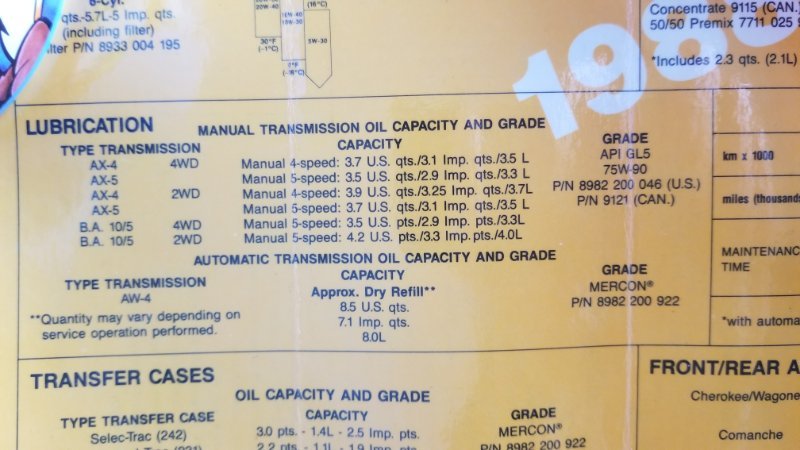
Now that you mention it, reverse has been tougher too. Our driveway slops, and if I let it roll out before putting it into reverse it's difficult. It's best to work the clutch a bit and get it into reverse before letting it roll. 20/50, interesting. I managed to scrounge up the fluid chart that came with mine, and it also says 75W-90 GL5 for the BA10/5. So the shop chose the right weight. I wonder if the tranny would prefer dino juice. Honestly, as far as I've been able to determine synthetic oil IS oil, it just has a much more consistent size/viscosity.
-
No signs of leaks, yet. I'm such a noob at mechanicals, I didn't even think to check fluid levels. I'm in a hotter climate here in Phoenix, I don't know if that calls for something different. I will try, really try, to find a bottle of something with numbers similar to what the owner's manual specifies. :)
-
Last week I took it out and suddenly the transmission (BA10/5) realllly doesn't like going out of 1st and up to 2nd. They're crunching really good. Third is easier, and 4th and 5th are fine, so the clutch seems to be doing its job. If I get the RPM's up (as cruiser would recommend :) ) 1st to 2nd comes a little easier. Once it's warmed up a bit it shifts significantly better. I had to get a new clutch not long after getting my '88 earlier this year. They suggested a transmission fluid change so I thought yeah, good idea while it's in the shop. The service receipt says they used 75W-90, full synthetic, but the brand is question marks. I've seen threads that indicate "I was crunching gears until I switched to transmission fluid X." I know, you can find a thread for any problem where changing the brand of some liquid fixes it. But is there any truth to that? The sudden onset of this behavior makes me wonder if it's more mechanical in nature, synchros going or something. But, if a better transmission lubricant really fixes it, I'm all ears.
-
Injector recommendations
brucecooner replied to brucecooner's topic in MJ Tech: Modification and Repairs
Would a Renix have the CPS issue? I've heard heat soak of the CPS can cause hard starts. I imagine, however, that would occur when you attempt any warm start, and I don't get that. It has to sit for a while to get the difficult start. Another culprit could be some longer term effect in the fuel system, but that's a guess at this point. -
Injector recommendations
brucecooner replied to brucecooner's topic in MJ Tech: Modification and Repairs
It's been cold starting and running pretty well. I'd been taking it out to run errands to see if the hot start issue was still there. If I go in a store for a few, come back within 10-15 minutes it'll start. But I stopped at the local burger joint long enough to eat the other day, and when I got back in got the difficult start again. Cranked for a few seconds, didn't want to start. It did start, just not as peppy a fireup as I'd gotten used to. So injectors didn't fix it, but they needed replacing anyway so it was a good idea. But I guess there's still something to look for. Given that it takes a chunk of time (30-45 minutes) for it to display this behavior, does that point to anything in particular? I've heard the 4.0's sitting will vaporize fuel in the rail, and some guys swear wraparound foil heat shielding on the rail fixes it, but I would think if that was the problem my short stops at the store would have been enough to produce the problem. I do plan to perform cruiser's fuel pump tips soon.