

ruralandalone
-
Posts
159 -
Joined
-
Last visited
Content Type
Profiles
Forums
Gallery
Everything posted by ruralandalone
-
Thanks for that. I think I did add a description to my signature, but in any case its an 86 with a 2.5l
-
Can anyone tell me exactly where this is located?
-
Wrong Universal joint strap replacement?
ruralandalone replied to ruralandalone's topic in MJ Tech: Modification and Repairs
Thanks! -
Wrong Universal joint strap replacement?
ruralandalone replied to ruralandalone's topic in MJ Tech: Modification and Repairs
DO you have a recommended source? Rockauto does not seem to list a kit as such -
Wrong Universal joint strap replacement?
ruralandalone replied to ruralandalone's topic in MJ Tech: Modification and Repairs
Great idea! I had simply replaced what was there. I did not know about the u-bolts. Do I have to drill out the yoke screw holes, or are these simply plug-n-play? -
As part of my rebuild I ordered replacement straps for one of my universal joints. According to rockauto it is the correct strap (UJ43710) But it is shallower than the original, so that the ends of the strap are not touching the mount, but sit off about 1/8 of an inch on each side. This does not look as strong to me. I don't know if there is a better brand for this part (mine are SKF), or if this is a generic part, and all that is available in this day and age. Anyone have experience with this?
-
UV joint disassembly
ruralandalone replied to ruralandalone's topic in MJ Tech: Modification and Repairs
Sounds doable. Better than anything I came up with. -
UV joint disassembly
ruralandalone replied to ruralandalone's topic in MJ Tech: Modification and Repairs
Thanks. Seen it. The problem is that the cups are much harder to get out. No wrench I own will apply sufficient grip. The caps just slip off in the video. I use a press to move the cups, but they only can be pushed so far. After that they have to be pulled..... -
UV joint disassembly
ruralandalone replied to ruralandalone's topic in MJ Tech: Modification and Repairs
Replaced, by all means. Definitely been abused, and not lubricated much. Fingers are NOT a suitable tool for this job! :) -
I have a simple question for you folks: What tool do you use to remove the end caps on the uv when you are disassembling them? In the youtube vids the guy simple removes them with a set of pliers. Mine, on the other hand, look like they are original to the jeep. No wrench or plier that I have seems to provide enough grip to pull off the caps. So far the best I have been able to do is to work the caps back and forth, lubricating with liquid wrench each time, until they are loose enough to get a grip Any suggestions?
-
4 wheel drive puzzle
ruralandalone replied to ruralandalone's topic in MJ Tech: Modification and Repairs
Thanks for all of the information. My mechanic buddy had a look and feels that everything is working as it should. Live and learn!! -
4 wheel drive puzzle
ruralandalone replied to ruralandalone's topic in MJ Tech: Modification and Repairs
I was indeed referring to the inner axle shaft on the passenger side of the front axle . The shaft onto which the slider goes when it engages via the cad. By "gear" I was referring to the teeth cut on the end of the shaft. The way I see it, I should not be able to turn the driveshaft by hand with the inner shaft (at the cad) locked in place with a screwdriver. And what I certainly don't understand is how the driver side wheel is connected and disconnected via the cad. The passengers side would seem to be self evident. I looked at the drawing you provided (I have the parts cd) but I confess I don't see the connection. -
4 wheel drive puzzle
ruralandalone replied to ruralandalone's topic in MJ Tech: Modification and Repairs
I agree. I just wanted to see if it would work. Am I correct in thinking that the gear on the left should be directly and firmly coupled to the driveshaft? -
4 wheel drive puzzle
ruralandalone replied to ruralandalone's topic in MJ Tech: Modification and Repairs
I pulled the CAD off, cleaned it up, moved the sleeve over, and tried it by hand. If I turn the driveshaft by hand the wheels turn. Looks good. Also discovered that, while the vacuum unit itself looks good, the vacuum lines are rotted to the point that they leak. So the vacuum lever is not going to work. Since the fork stayed where I put it, I figured I would simply reinstall it without removing the c clip, and see what happens. I started the engine, put it into 4wd, and looked at the results. The front wheels turn. Sort of. Certainly not at the speed of the rear wheels. In fact I could stop them with my foot. Odd. Took the CAD off and the fork had not moved. I moved the sleeve to the disengaged position. I discovered that if I put a screwdriver on the drive gear (on the left) I could turn the driveshaft by hand and the gear would not move. So it seems that there is major slippage somewhere between the driveshaft and that gear. Any suggestions how/where to proceed? -
4 wheel drive puzzle
ruralandalone replied to ruralandalone's topic in MJ Tech: Modification and Repairs
That is wonderful!!!!!! Nice clear instructions and I should have no trouble doing it. I took the vacuum lines off at the actuator this morning and 2 of the 3 are completely full of rust. It does not look like mine has worked for a LONG time. Does it matter if I plug the 3 lines or not? OR just hook them back up even though they are not going to do anything? BTW, the whole concept of a disconnect seems like a needless complication to me. More to break for a minor reduction in parts wear and a (perhaps) minor increase in mileage... -
4 wheel drive puzzle
ruralandalone replied to ruralandalone's topic in MJ Tech: Modification and Repairs
SO, the command trac control works. At least as far as the front drive shaft. Unfortunately the front wheels don't spin in 4wd. So there is likely a problem - maybe with the vacuum actuator? I am open to suggestions as to how to diagnose this further... -
4 wheel drive puzzle
ruralandalone replied to ruralandalone's topic in MJ Tech: Modification and Repairs
Thanks for taking the time to help me out. No need for a picture - You are clearly correct. The truck has "command-trac" and only one lever. Now to see if I can get it to work (after re-reading the manual a few times). Upon reflection, it was rather a stupid question. More research on my part would likely have found the link between the transfer case model and the type of drive. -
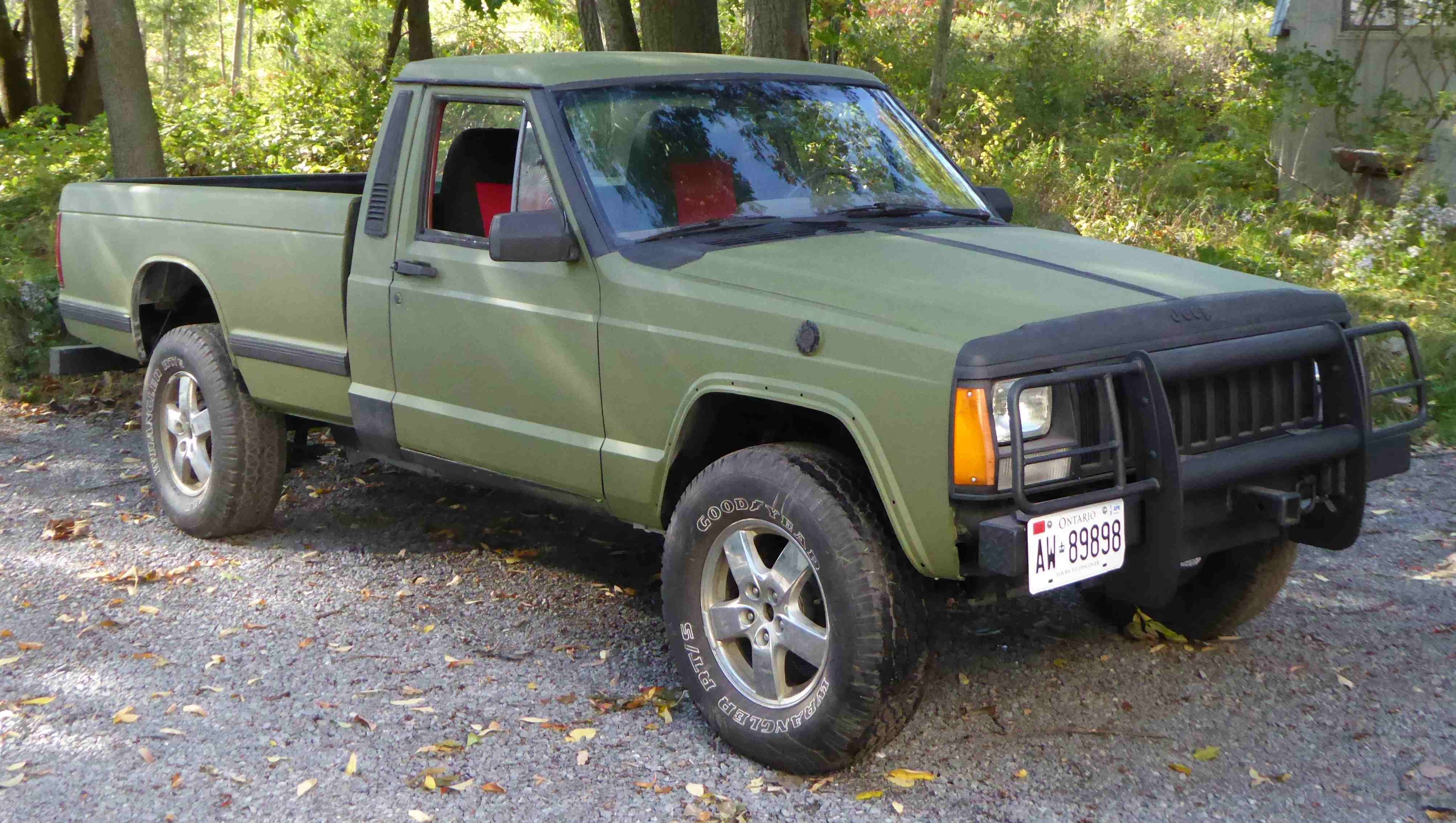
I apologize for what might be a really strange post. Any help or suggestions would be appreciated. I am continuing my restoration project on my 1986 Commanche 2.5l gas pickup. Four wheel drive. I know it is 4 wheel - from underneath - but: I am in the process of starting on the interior, and I was looking at the high-low lever and the shift lever. What has become rather obvious is that there is no "select-trac" lever on the plastic surrounding the stick shift. Nor is there any place for one. So either the surround is not original, or it is not a ":selec-trac" transfer.. Further investigation shows that the transfer case is a New Process Gear 207AM3. So here are my (admittedly odd) questions: 1) What kind of control did (does) this transfer case have? Is it a mechanical lever, an electrical switch, a vacuum switch, or what? 2)Is this the right transfer for an 86? 3)What parts am I missing? My previous experience is only with military 4wd vehicles. This jeep is the youngest vehicle I have ever worked on, and I admit I am out of my depth. Levers I can figure out....
-
Help wiring a new alternator
ruralandalone replied to ruralandalone's topic in MJ Tech: Modification and Repairs
Just a brief follow-up. I had a quick look at the wiring (it's still cold out there!) and it appears that the red wire on thh side of the alternator (rotor) and the red wire on the back join together close to the alternator, and then run back to a fusable link and then to the battery. So when I replace the alternator and charging wire I won;t bother with the side red wire. I'll just hook up the voltmeter. -
Help wiring a new alternator
ruralandalone replied to ruralandalone's topic in MJ Tech: Modification and Repairs
Likely the wire from my alternator goes to the starter relay as well, as I don;t think it goes directly to the battery. So as long as there is 4 gauge back to the battery I should be good. Now I just need warmer weather... Thanks to all who responded! -
Help wiring a new alternator
ruralandalone replied to ruralandalone's topic in MJ Tech: Modification and Repairs
I believe so, yes it should -
Help wiring a new alternator
ruralandalone replied to ruralandalone's topic in MJ Tech: Modification and Repairs
TO answer your questions: 1) the back does not look like that. Mine only has 1 wire and the 2 terminal plug. 2) yes -
Help wiring a new alternator
ruralandalone replied to ruralandalone's topic in MJ Tech: Modification and Repairs
The winch and electric pump are not in the equation - yet. As far as I can tell, since this is a "1-wire" replacement alternator, I don't HAVE to hook anything up but the direct link to the battery. This wire has to be added because the original does not appear to go directly to the battery and the gauge is too small. When it gets a bit warmer I'll deconstruct the harness and find out where the two red wires actually go. My thought at the moment is that I will connect the 2 side wires as well - although perhaps not at first. I'm not sure how much wiring has been replaced, but I don;t think too much has changed from OEM. The problem is my lack of understanding. This is much more complicated than my 50's and 60's vehicles and I am, at best, feeling my way. So I very much appreciate everyone's comments! -
Help wiring a new alternator
ruralandalone replied to ruralandalone's topic in MJ Tech: Modification and Repairs
First of all, I have to apologize, because I am full of crap and most of what I said previously is in error. So lets start again. My current wiring is as follows: Medium heavy red wire to the back of the current alternator. Medium heavy red wire to the side of the alternator. Brown wire with stripe to side of alternator. Heavy red wire going from battery to the wiring harness (heavier than those on the alternator. I don't yet know where this goes, and I will have to open the harness to find out. Assuming that I replace the wire on the back of the alternator with something heavier and run it directly to the battery, do I NEED to hook up the other wires, or should I simply plug them into the new one and assume the wiring is the same? -
Help wiring a new alternator
ruralandalone replied to ruralandalone's topic in MJ Tech: Modification and Repairs
The unit is a powermaster 47293 . These units can run as a 1 or 3 wire alternator. The info is on page 68-69 in the catalogue at http://www.powermastermotorsports.com/catalog.html. I understand that the alternator will happily run with one wire. It's where / how to hook up the switch and voltmeter wires that I am uncertain about.